

Helicopter Volcano Landing
The most reviewed Tarawera landing flight, rated by 43 reviewers, putting you on the summit for a guided walk of about 20 minutes at the pilot's discretion.
Check availability
Compare every Volcanic Air scenic flight over Rotorua in one place, from quick hops to full volcano landings. Use the flight-length ruler below to filter Rotorua helicopter tours by duration, from 15 to 180 minutes.
The most reviewed Tarawera landing flight, rated by 43 reviewers, putting you on the summit for a guided walk of about 20 minutes at the pilot's discretion.
Check availabilityNZ$395 per person, from-price
A 40 minute floatplane flyover, 30 of them in the air, taking in Tarawera's craters, Waimangu Volcanic Valley, the crater lakes and Pohutu Geyser.
Check availabilityNZ$675 per person, from-price
A 40 minute helicopter flight with a guided walk on the Mt Tarawera summit, commentary from the guide included and food and drinks not.
Check availabilityA Tarawera summit landing flight capped at six travelers with a 110 kg per passenger weight limit.
Check availabilityA 15 minute floatplane over the crater lakes, taking off from Lake Rotorua itself and climbing around Mokoia Island, a native bird sanctuary.
Check availabilityThe cards run from the most reviewed flight down to the newest listings. At the top sits the Mt Tarawera Helicopter Tour with Volcano Landing, rated 4.9 from 43 reviews, the largest review base of any flight leaving 1 Lakefront Drive. Next comes the Scenic Flight over Mt Tarawera and Waimangu Valley, a floatplane flyover rated 4.9 from 28 reviews, listed from NZ$395 per person. Third is the Helicopter Flight and Guided Walk on Mt Tarawera, rated a perfect 5.0 from 12 reviews and listed from NZ$675.
The middle of the order mixes aircraft. The Mount Tarawera Volcanic Adventure by Helicopter carries 11 reviews, and the 15-Minute Crater Lakes Flight by Floatplane matches that count on the same time budget. Below them the Dual Landing Thermal Explorer, rated 5.0 from 10 reviews, lands at both Mt Tarawera and Orakei Korako by helicopter.
Seven of the flights are helicopter and six are floatplane. The split matters most at the summit: only helicopters land on Mt Tarawera, and the floatplane Tarawera flights are flyovers. Two floatplanes do land, one at Orakei Korako on the Waikato River and none at Whakaari, where flights over the island stay in the air.
The ratings reflect the whole booked experience, the flight, the pilot and the landing or walk where one is included, not a safety audit or an aircraft comparison. Two listings carry 5.0 ratings on small review counts, and the longest helicopter trip has just 2 reviews, so a low count signals a newer listing rather than a weaker flight. Every one of the thirteen can be cancelled free up to 24 hours before departure.
Loading the map. Every place is also listed below.
Map tiles and place names: © OpenStreetMap contributors
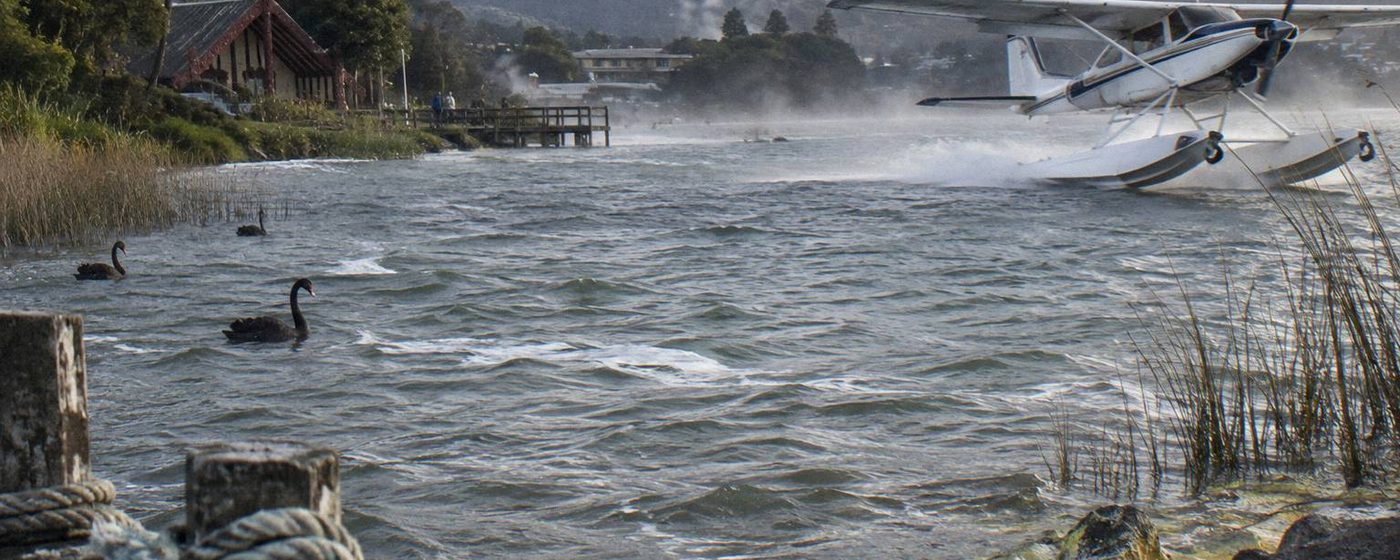
Helicopter passengers arrive 30 minutes before departure for a full safety briefing; floatplane passengers arrive 20 minutes before. The base sits under 1 km from the Rotorua centre, so the walk from town is short. Helicopters lift off from the Lakefront itself. Floatplanes taxi out from the lakefront pier and take off from the water of Lake Rotorua.
| Aircraft | Check-In | Take-Off |
|---|---|---|
| Helicopter | 30 minutes before departure at the Lakefront office, with a full safety briefing | From the Rotorua City Lakefront |
| Floatplane | 20 minutes before departure at the Lakefront office, with a full safety briefing | From the lakefront pier, taking off on Lake Rotorua |
From the base the shortest route lines loop over the crater lakes country close to home, over Sulphur Bay and Mokoia Island, a native bird sanctuary the floatplanes climb around after take-off. The Tarawera lines track southeast across lakes Okareka, Okataina and Tarawera to the mountain itself, where the helicopter routes end at the summit and the floatplane routes bend south over Waimangu Volcanic Valley, formed along the 1886 rift, before turning home.
The longest line runs northeast to Whakaari, about 48 km off the coast of Whakatane. Rotorua helicopter tours reach it on the 1 hour 45 minute Volcanic Extremes flight, which returns via a Mt Tarawera summit landing, while the floatplane versions take a two hour path over the island, Tarawera and the lakes district, with the Bay of Plenty coastline below.
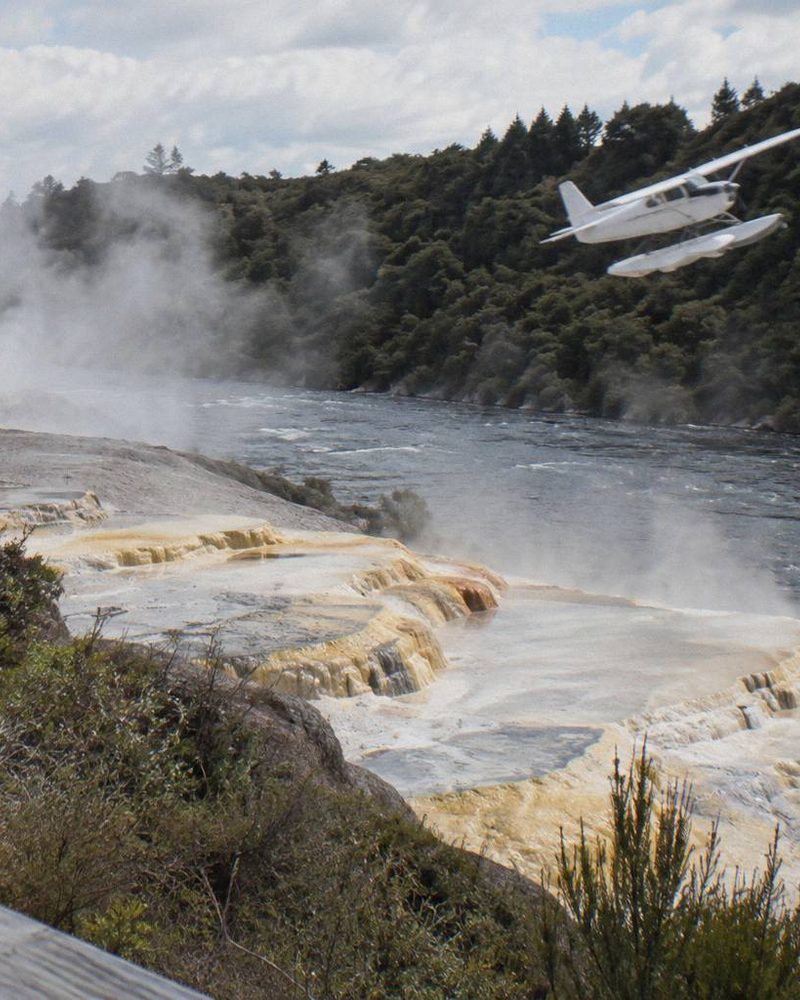
A fourth line points northwest from the lake to Orakei Korako, on the Waikato River at Lake Ohakuri, between Rotorua and Taupo. The floatplane touches down on the river there; the 3 hour helicopter tour lands on Tarawera first, then stops at the geothermal park, reached by a ferry crossing from the far bank.
| Lake Or Place | What The Operator Says |
|---|---|
| Mokoia Island | The floatplane climbs around it after take-off; a native bird sanctuary |
| Rotoiti, Okataina, Okareka | Revealed beneath the flight line toward Mt Tarawera |
| Tarawera and Rotomahana | Lake Rotomahana sits on the line of the 1886 rift |
| Rotokakahi (Green Lake) and Tikitapu (Blue Lake) | Named among the crater lakes in view |
| 12 crater lakes in total | Stated for the crater lakes flight |
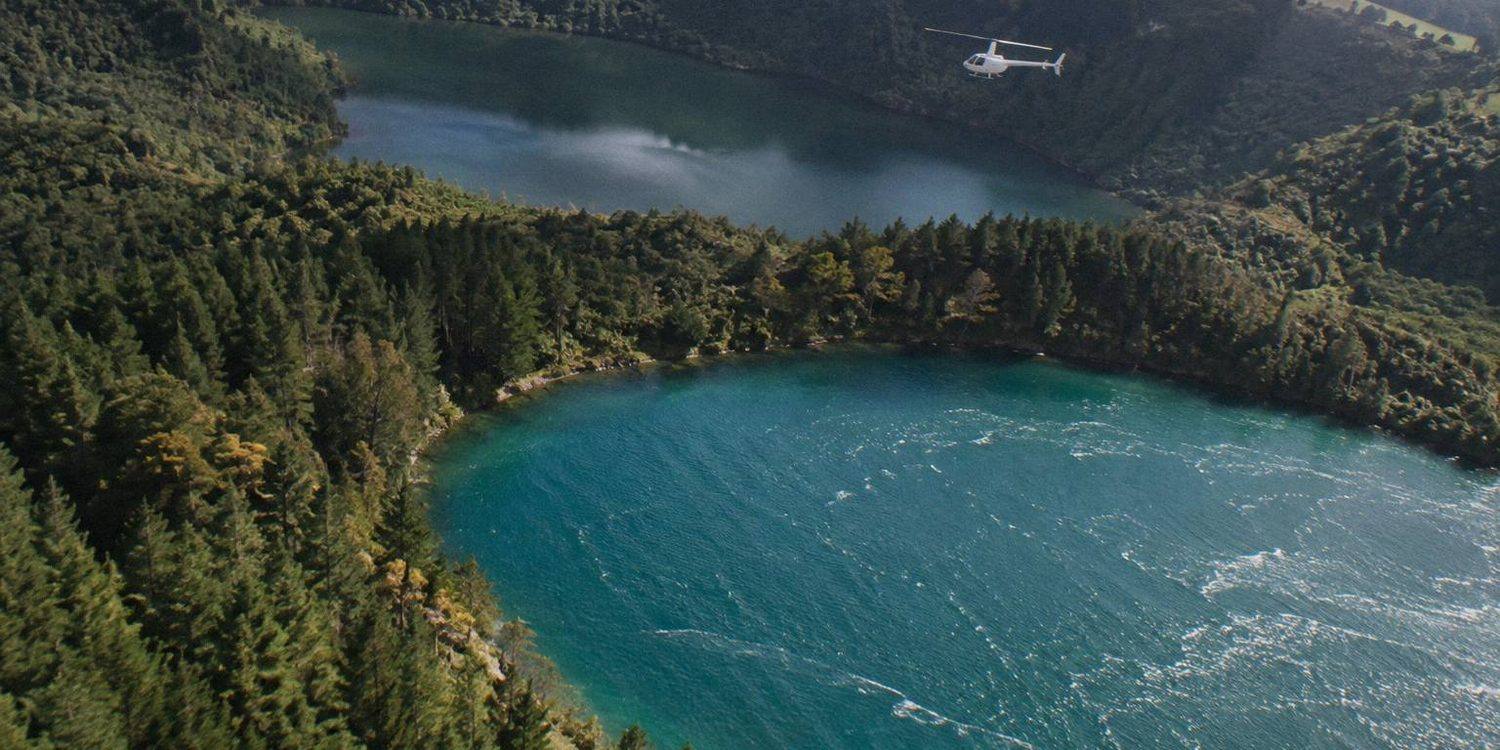
The crater lakes are the backbone of every local route. The operator names Rotoiti, Okataina, Tarawera, Okareka, Rotomahana, Rotokakahi (Green Lake) and Tikitapu (Blue Lake) among the lakes in view, and states 12 distinct crater lakes for the crater lakes flight. Tarawera is the biggest draw, a lake sitting beside the mountain that bears its name, and Rotomahana lies directly on the line of the 1886 rift, its modern shape a product of the eruption.
Green Lake and Blue Lake sit close together southwest of Tarawera, and Okareka and Okataina string out along the flight path toward the mountain. Closer to base, the routes cross Sulphur Bay on the lakefront and swing past Mokoia Island, the native bird sanctuary at the centre of Lake Rotorua that floatplanes circle as they climb away from the pier.
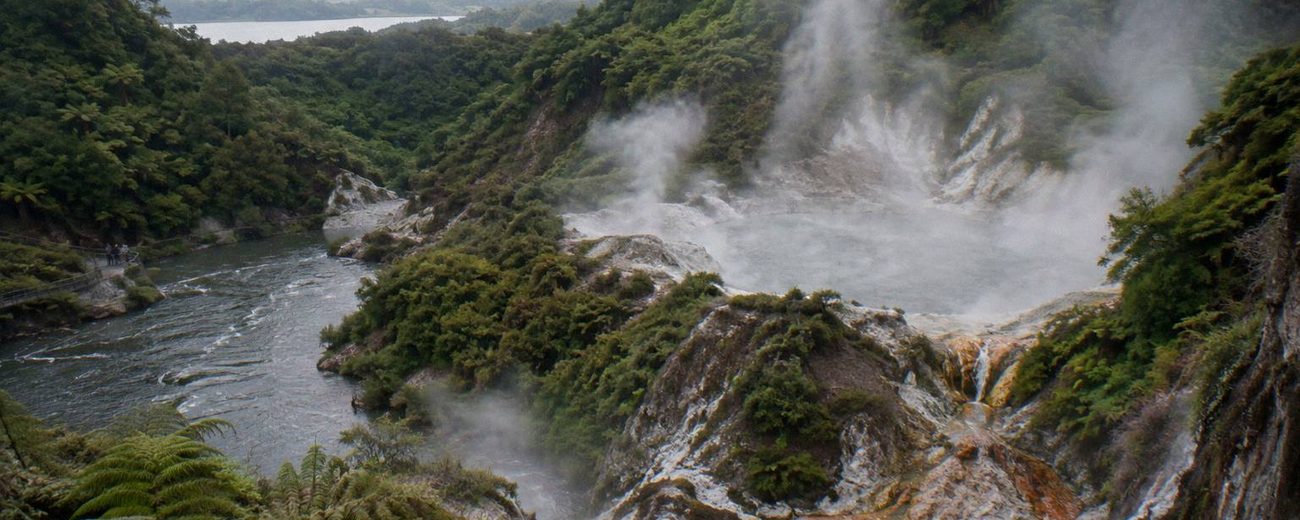
South of Tarawera the ground drops into Waimangu Volcanic Valley, about 14 km from Rotorua, a geothermal system the valley's own operators date to the night of 10 June 1886. Flyover routes cross it after passing the mountain; the shortest Tarawera floatplane pairs the two in one 40 minute loop.
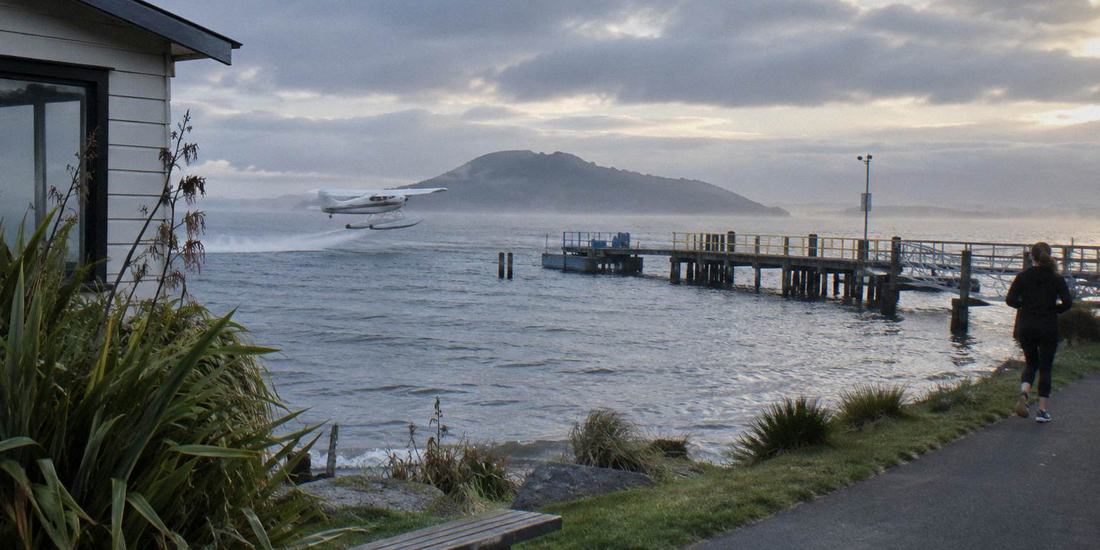
Orakei Korako sits on a different line altogether, northwest toward Taupo, and its position explains its landing: the geothermal field lies on the Waikato River at Lake Ohakuri and is reachable across the water by a short ferry ride. A floatplane can land on that winding river directly, which is why the Orakei Korako flights are the ones that trade the volcanic plateau for the river valley, returning over farmland and the Paeroa Range.
Every Tarawera flight crosses the aftermath of one night. In the early hours of 10 June 1886, Mt Tarawera erupted, opening a rift that GNS describes as 17 km long, running across the mountain top, through Lake Rotomahana and into the Waimangu Valley area. GNS records that more than 100 people were killed in villages near the mountain. Te Wairoa was razed and all but covered with ash and mud, and survives as the Buried Village at 1180 Tarawera Road.
The eruption buried the famous silica hot springs known as the Pink and White Terraces. GNS says the White Terraces were largely destroyed, and that remnants of the Pink Terraces may lie at the bottom of Lake Rotomahana, the lake the eruption reshaped into its present size.
The helicopter flights to the summit cross the lakes country first, over Okareka, Okataina and Tarawera, before reaching the mountain's rift and craters. The operator's own flight wording counts 8 km of rift over the mountain, the stretch of the longer GNS line that runs across the summit itself. From the air the domes of Ruawahia, Tarawera and Wahanga line up along the ridge, with Ruawahia the highest point at 1,111 m.
| What | Source Record |
|---|---|
| Date | 10 June 1886; GNS gives the start as 1.30am, Te Ara as around 2 a.m. |
| The rift | GNS: a 17 km long rift across the mountain top, through Lake Rotomahana and into the Waimangu Valley area; the Volcanic Air landing flight crosses 8 km of rift and craters |
| Te Wairoa | Razed and all but covered with ash and mud; now the Buried Village at 1180 Tarawera Road |
| Lives lost | GNS: more than 100 people were killed in villages near the mountain |
| Pink and White Terraces | Buried; GNS says the White Terraces were largely destroyed and remnants of the Pink Terraces may lie under Lake Rotomahana |
| Question | Answer |
|---|---|
| Who governs the mountain | The Ruawahia 2B Trust; Ngati Rangitihi hold kaitiakitanga of the maunga |
| How visitors get on | Through concessionaires: Kaitiaki Adventures on foot and Volcanic Air by helicopter landing |
| Where the money goes | The Trust reinvests most tourism concession revenue in conservation, wilding pine removal first |
| Who decides a landing | The pilot, at his or her sole discretion, on the day |
The floatplane Tarawera flights cover the same ground without stopping, pairing the mountain flyover with Waimangu Volcanic Valley, whose geothermal system the valley attributes to that same June night. However the route is cut, the 1886 rift is the thread that ties the whole flight together, from the summit craters to the buried lake to the valley it created.
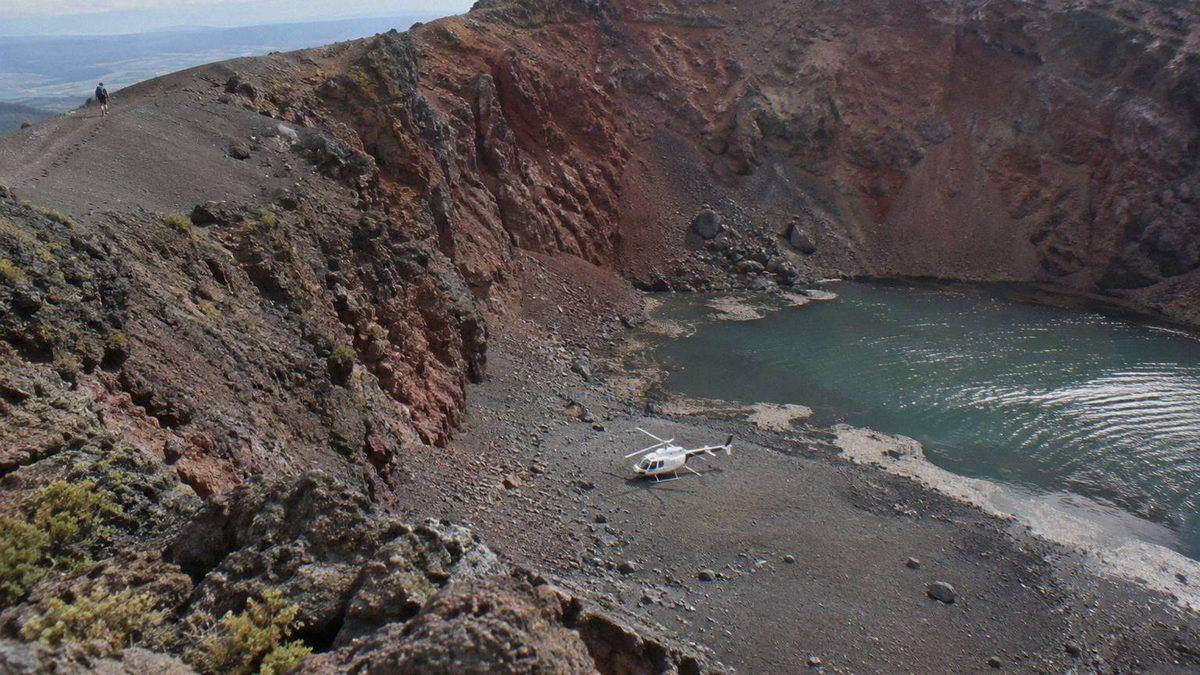
The helicopter landing is the only way onto the top short of a guided walk, and it comes with conditions. The operator's wording is precise: fly over Mt Tarawera's 8 km rift and craters, then land on the summit for a 15 minute guided walk. Tour duration, flight times and inclusions may vary with weather, volcanic activity and passenger loadings, and excursion landings are undertaken at your own risk, at the pilot's sole discretion. A landing is never a certainty; it is a decision made on the day by the person flying the aircraft.
The mountain is not open ground. The Ruawahia 2B Trust governs Mt Tarawera and reinvests most tourism concession revenue in conservation. Ngati Rangitihi hold kaitiakitanga of the maunga, carrying, in the Trust's words, the deep responsibility of protecting the mountain as guardians. Volcanic Air works the air side as a concessionaire alongside Kaitiaki Adventures, which runs guided walks on foot.
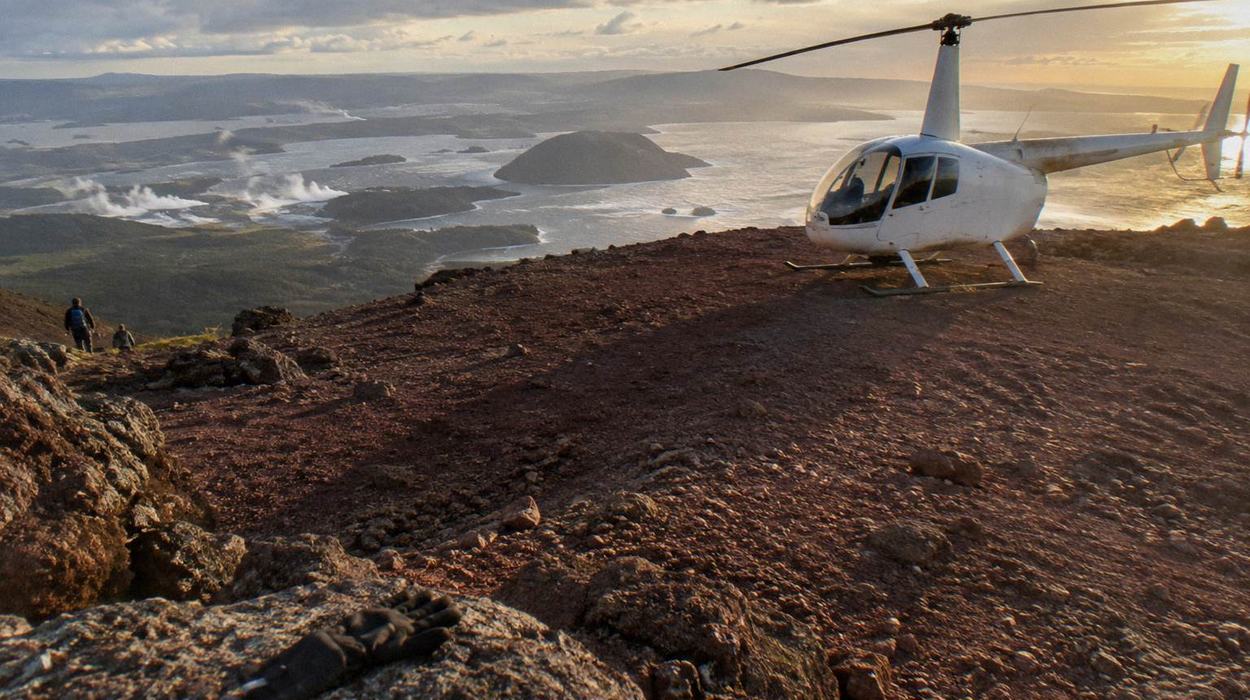
Independent summit access is not permitted; the routes up run through authorised guided tours or approved helicopter landings. That structure is why the landing flights cost more than the flyovers and why the guided walk on the summit is led rather than free ranging. The longer guided walk flight stretches the visit, with commentary from the guide across the 40 minute experience, listed from NZ$675 per person. The shorter volcano landing tour carries the biggest review base, 43 reviews at 4.9, which makes it the most flown version of the only summit access a helicopter can buy.
The chooser starts with the kind of flight. A Mt Tarawera landing needs a helicopter; the floatplanes fly over the mountain and land only at Orakei Korako, on the Waikato River. Anyone fixed on Whakaari should know that every Whakaari flight is a flyover, whether floatplane or the 1 hour 45 minute helicopter that adds a Tarawera summit landing on the way home.
Second, time. Under 45 minutes covers the two 15 minute crater lakes hops and the 40 minute Tarawera flights, the guided walk flight and the Tarawera and Waimangu flyover. Between 45 minutes and 2 hours sit the Orakei Korako floatplane at 2 hours and the 1 hour 45 Volcanic Extremes helicopter. Over 2 hours means the two 3 hour dual landing tours, Tarawera plus Orakei Korako by helicopter.
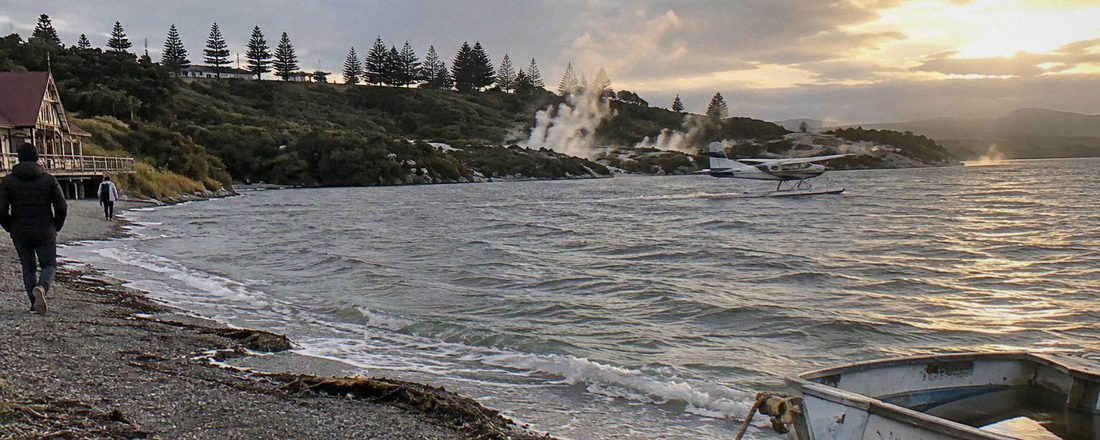
Third, spend per person. Five flights carry listed from prices: NZ$395 for the Tarawera and Waimangu flyover, NZ$675 for the helicopter landing with guided walk, NZ$845 for the Orakei Korako floatplane, NZ$1,230 for the White Island, Tarawera and Waimangu floatplane, and NZ$1,490 for the 3 hour dual landing helicopter tour. Free cancellation up to 24 hours applies across all thirteen, so the choice can be made early and adjusted later.
A starting shortlist of well-reviewed flights. Answer a question or two to rebuild it around your plans.
40 minutes · Free cancellation
40 minutes · Free cancellation
15 minutes · Free cancellation
2 hours · Free cancellation
2 hours · Free cancellation
1 hour 45 minutes · Free cancellation
15 minutes · Free cancellation
The 15 minute hops, one by helicopter and one by floatplane, both spend all 15 minutes in the air over the crater lakes. They suit a tight schedule or a first taste of flying from the Lakefront, and the floatplane version adds a take-off from Lake Rotorua itself.
The 40 minute flights are the Tarawera core. The floatplane flyover covers the mountain and Waimangu Volcanic Valley in 30 minutes of flying, listed from NZ$395. The helicopter version at the same overall length lands on the summit for the guided walk, listed from NZ$675, trading air time for time on the mountain.
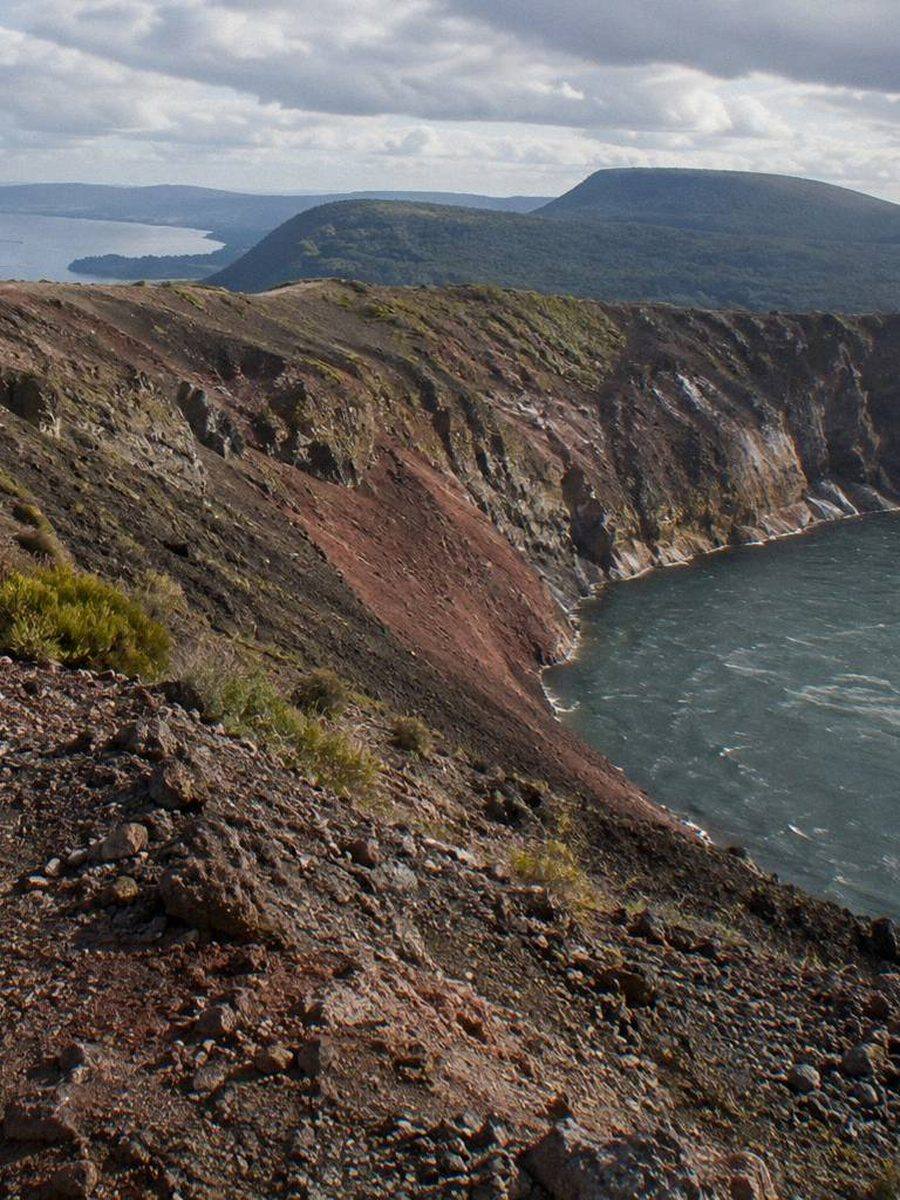
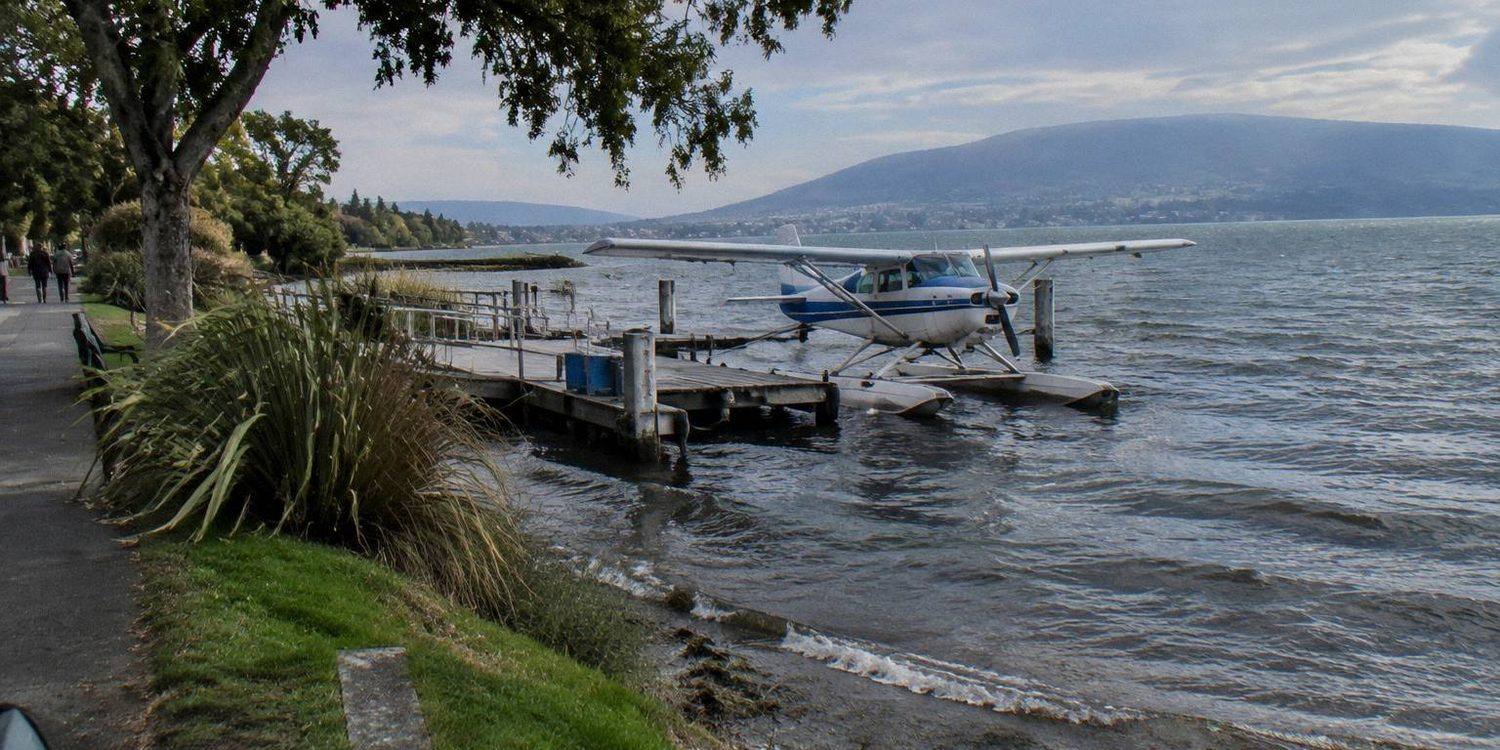
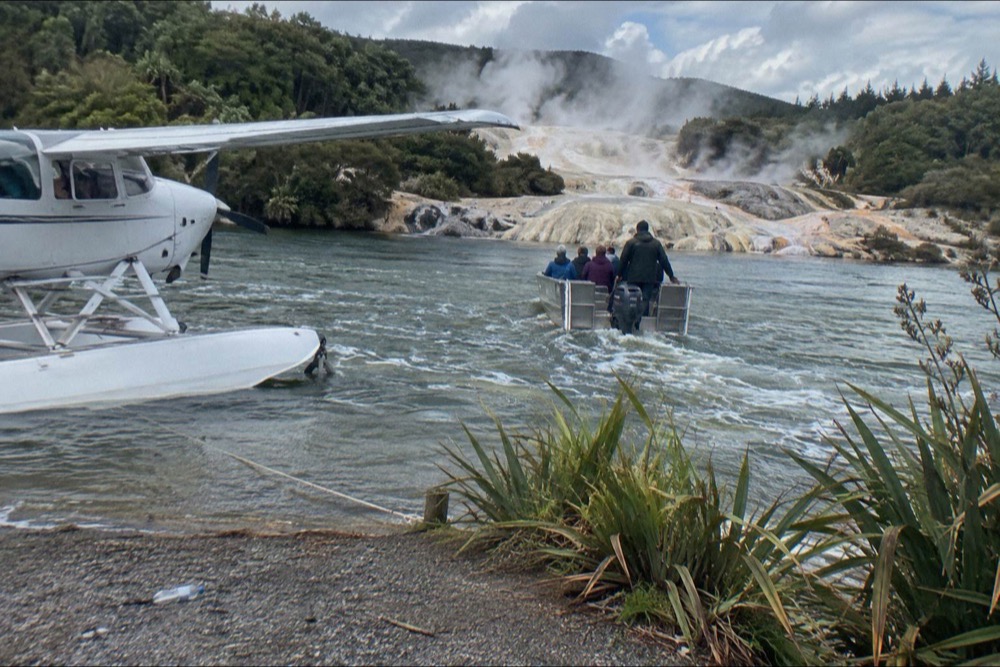
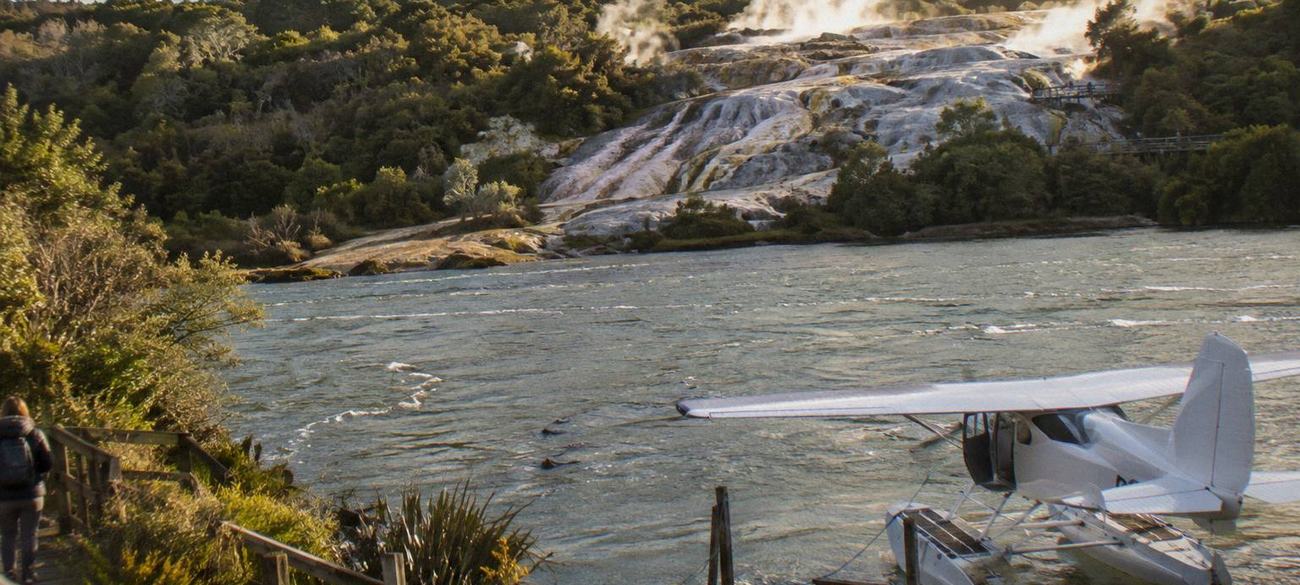
The two hour floatplanes divide by destination. The Orakei Korako flight, from NZ$845, lands on the Waikato River and includes a self guided walk at the geothermal field. The White Island, Tarawera and Waimangu flight, from NZ$1230, stays airborne across Whakaari, the mountain, the valley, the lakes district, farms, orchards and the Bay of Plenty coastline, with pilot commentary throughout.
The 1 hour 45 minute Volcanic Extremes helicopter is the flyer's compromise: Whakaari by air and a Tarawera summit landing in one trip. The 3 hour tour, from NZ$1490, is the full day compressed: the summit landing and guided walk, the flight to Orakei Korako, the ferry crossing and an hour of self guided walking among the geysers, with meals left to the traveller.
The two aircraft share a check in desk and split almost everything else. A helicopter departs from the Lakefront itself and can set down on ground a floatplane cannot touch: the summit of Mt Tarawera, where the landing flights put passengers on the crater rim for a 15 minute guided walk, and the geothermal park at Orakei Korako on the 3 hour tour.
Landing is at the pilot's sole discretion, and every summit touchdown carries that condition. Seven of the thirteen flights are helicopter, including all four Tarawera landing products and the 1 hour 45 minute Volcanic Extremes run to Whakaari and back.
A floatplane begins differently: it taxis from the lakefront pier and takes off from the water of Lake Rotorua, climbing around Mokoia Island, a native bird sanctuary in the middle of the lake. Six flights are floatplane, from the 15 minute crater lakes hop to the two hour Whakaari, Tarawera and Waimangu circuit with its views over the Bay of Plenty coastline.
| Aircraft | Where It Lands | Flights On The Roster |
|---|---|---|
| Helicopter | Summit of Mt Tarawera for a 15 minute guided walk, at the pilot's sole discretion; geothermal park landing on the longest flight | Mt Tarawera landing and guided walk; volcano landing and geothermal park tour |
| Floatplane | Takes off from Lake Rotorua; touches down on the Waikato River at Orakei Korako on that flight; no landing on Mt Tarawera or Whakaari | Crater lakes and Tarawera flyover; Orakei Korako landing; White Island and Tarawera flyover |
| Flight | Aircraft | Duration | Landing |
|---|---|---|---|
| Helicopter Flight and Guided Walk on Mt Tarawera | Helicopter | 40 minutes | Mt Tarawera summit |
| Scenic Flight Over Mt Tarawera and Waimangu Valley | Floatplane | 40 minutes | None, a flyover |
| Floatplane Flight With Orakei Korako Landing | Floatplane | 2 hours | Waikato River at Orakei Korako |
| Volcano Landing and Geothermal Park Helicopter Tour | Helicopter | 3 hours | Mt Tarawera and Orakei Korako |
| White Island and Mt Tarawera Floatplane Flight | Floatplane | 2 hours | None, a flyover of Whakaari |
Neither aircraft lands on Whakaari; both the floatplane versions and the helicopter Volcanic Extremes flight treat the island as a flyover. And on the shortest route the choice is purely aesthetic: the same 15 minutes over the crater lakes runs in both aircraft, one off the land, one off the lake.
Start with the landing. If standing on Mt Tarawera matters, the decision is made: helicopter. If the appeal is a take-off from Lake Rotorua, skimming the pier and lifting off the water past Mokoia Island, the floatplane delivers that and the helicopter cannot. If the draw is Orakei Korako, both aircraft can get you there, but only the floatplane lands on the river itself; the 3 hour helicopter tour arrives by air and crosses to the field by ferry.
Length narrows it further. Both aircraft fly the same 15 minute crater lakes hop, identical in the air, so that one is a pure aircraft preference at the shortest end. At 40 minutes the paths split: the floatplane gives 30 minutes of flying over Tarawera and Waimangu from NZ$395, while the helicopter spends its 40 minutes on a summit landing and guided walk from NZ$675.
Whakaari is the last fork. The floatplane route takes 2 hours, from NZ$1230, covering the island, Tarawera and Waimangu in one airborne loop with pilot commentary. The helicopter version runs 1 hour 45 minutes and adds the one thing no floatplane Whakaari flight can: a Mt Tarawera summit landing on the return leg. Rotorua helicopter tours hold the landing monopoly on that route by design, not marketing; the floatplanes are built for water, and the summit is rock. Free cancellation up to 24 hours applies whichever way the choice falls.
Five flights carry a listed from-price. The cheapest is the Scenic Floatplane over Mt Tarawera and Waimangu Valley at NZ$395 per person, a 40 minute experience of which 30 minutes are in the air, with aerial views of the dormant volcano, Waimangu Volcanic Valley, the Crater Lakes, Rotorua City and the Pohutu Geyser. At NZ$675 per person, the Helicopter Flight and Guided Walk on Mt Tarawera also runs 40 minutes and adds a landing on the summit with a guided walk and commentary from the guide.
Two flights list NZ$845 and NZ$1,230. The Floatplane Flight with Orakei Korako Landing, at NZ$845 per person, runs 2 hours: a flight over Rotorua's geothermal parks, a landing at Orakei Korako and a self-guided walk. The White Island, Mount Tarawera and Waimangu Volcanic Valley Floatplane Flight lists NZ$1,230 per person for 2 hours in the air, pairing Whakaari with Tarawera and Waimangu plus views of the lakes district, farms, orchards and the Bay of Plenty coastline.
The most expensive listed fare is NZ$1,490 per person for the Volcano Landing and Geothermal Park Helicopter Tour, a 3 hour flight that lands on Mount Tarawera with a guided walk, then crosses to Orakei Korako by ferry transfer for a 1 hour self-guided tour, with pilot commentary throughout.
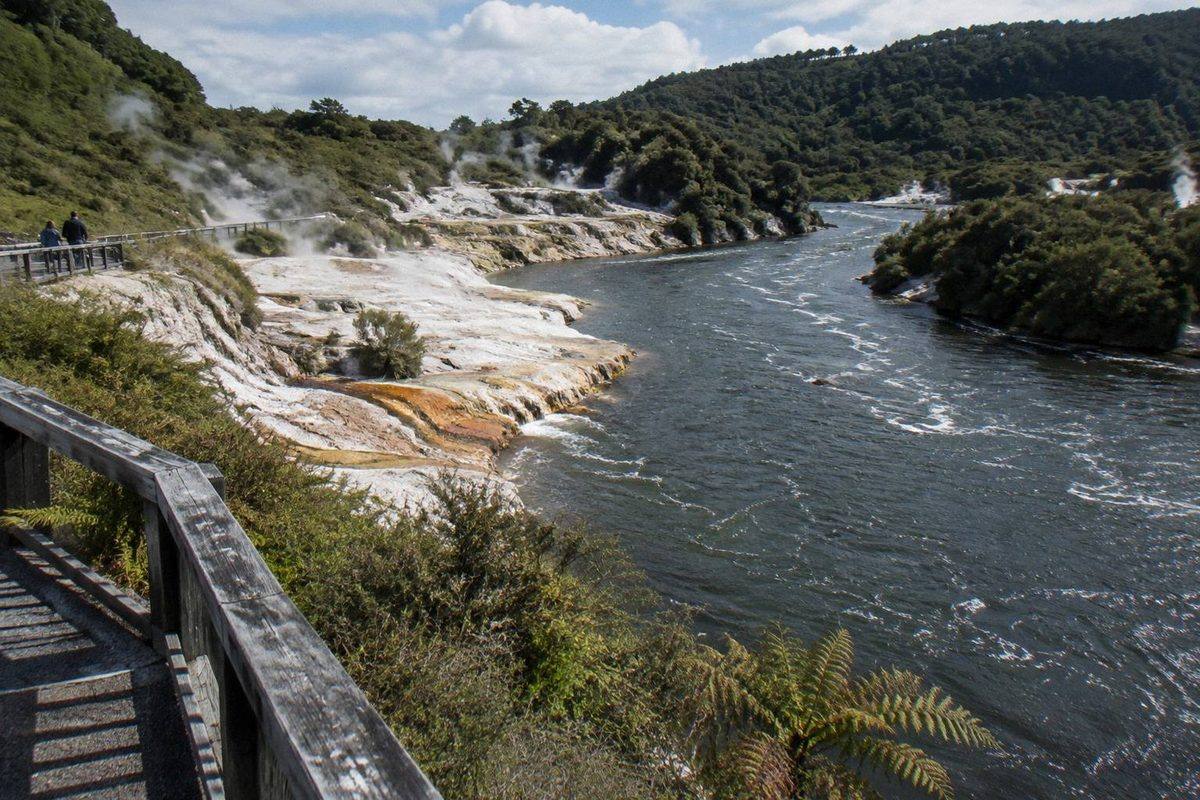
Divided by duration, the figures cluster into a clear ladder. The Tarawera and Waimangu floatplane works out to roughly NZ$9.88 per minute of the 40 minute experience, or about NZ$13.17 against its 30 minutes in the air. The guided walk helicopter at NZ$675 over 40 minutes is about NZ$16.88 per minute, reflecting the summit landing. The Orakei Korako floatplane at NZ$845 over 120 minutes is about NZ$7.04 per minute, and the White Island combination floatplane at NZ$1,230 over 120 minutes is about NZ$10.25 per minute, the distance to the offshore volcano driving the figure.
The 3 hour geothermal park tour at NZ$1,490 over 180 minutes is about NZ$8.28 per minute, the lowest per-minute rate among the flights with two landings and ferry transfer included.
Meals, drinks and food are excluded on several flights, and hotel pickup and drop-off is not part of the floatplane products; standard flights ask passengers to make their own way to the Lakefront, with direct pick-ups reserved for bespoke charters. Eight of the thirteen flights carry no listed from-price at all, and helicopter and floatplane fares generally move with date and seat availability, so the figure at booking is the one that counts.
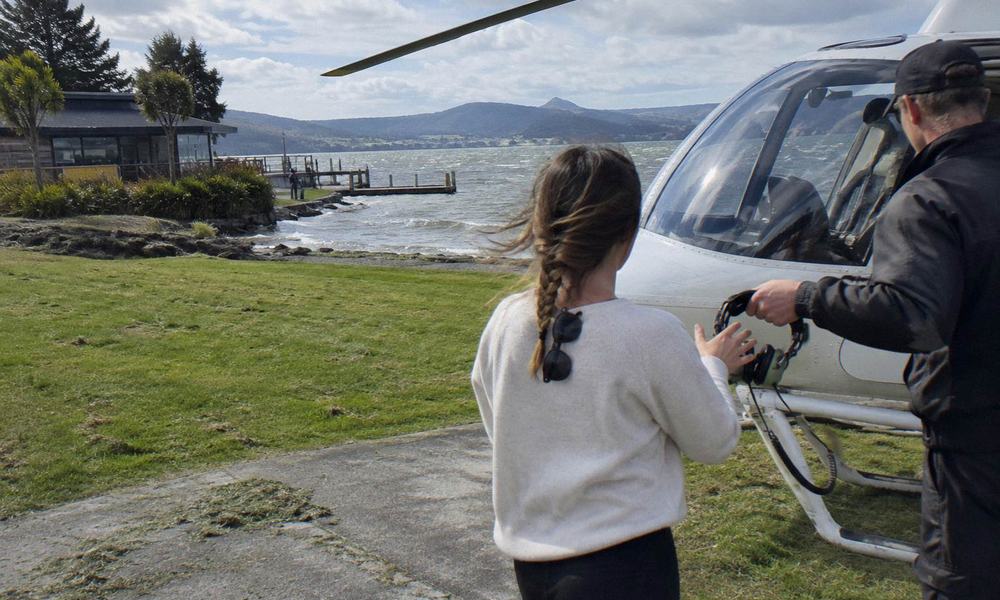
Children of all ages are welcome. Under 2s sit on a parent or guardian's lap, and child rates apply from ages 2 to 11. On the Mt Tarawera landing flight the specifics are stricter: a minimum of two adult fares applies, and children aged 2 to 11 pay 75 percent of the adult fare on that product.
Weights must be declared for every passenger at booking so seating stays balanced, and passengers are weighed on arrival. A declared weight that proves different on the day can mean rescheduling, a surcharge or cancellation. Several flights also note that passengers over 110 kg may be subject to specific seating arrangements.
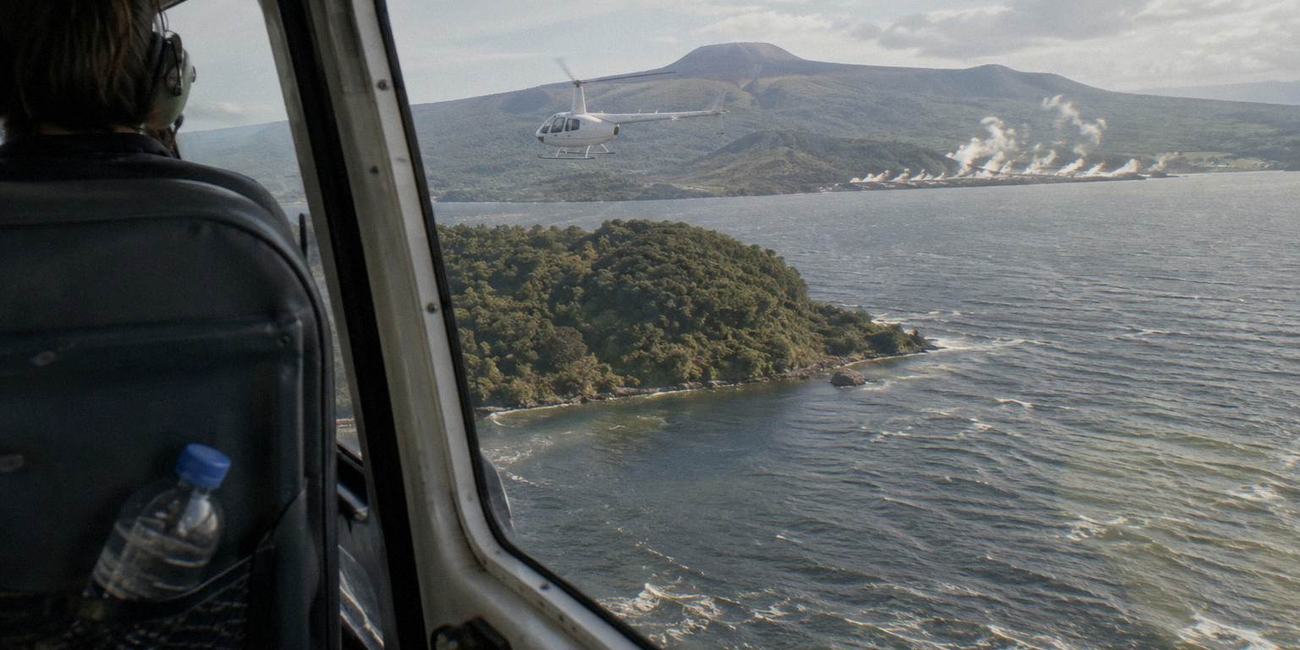
All thirteen flights, helicopter and floatplane alike, carry free cancellation up to 24 hours in advance for a full refund. That 24 hour window is the booking-page term that applies to these flights. Weather is treated separately: if conditions are unsuitable the operator works with passengers to reschedule or refund, and a cancellation before the flight starts for weather or volcanic activity brings a full refund. The practical read is simple: book early in a stay, keep the day flexible, and let the weather call be the pilot's.
On 9 December 2019 Whakaari / White Island erupted, resulting in the deaths of 22 people and injury to 25 others, according to the Coronial Court of New Zealand's inquiry page. The bodies of two victims were not recovered. The island lies about 48 km off the coast of Whakatane, and it had long been visited by boat and helicopter until that day.
| Question | Answer |
|---|---|
| Can you land on Whakaari | No; there are currently no boat tours to, or helicopter flights that land on, the island |
| What happened | The 9 December 2019 eruption killed 22 people and injured 25 others |
| How far off the coast | About 48 km off Whakatane |
| What the Rotorua flights do | Fly over and circle the island from the air, weather permitting |
| Current alert level | Set by GeoNet and changes often; check GeoNet before travel |
The change since has been absolute on the ground. Tourism New Zealand's current guidance states that there are no boat tours to, and no helicopter flights that land on, the island. Every Whakaari product sold from Rotorua today is a flyover: the aircraft approach, circle and return without touching down. No Rotorua helicopter tours land on Whakaari, and none claim to.
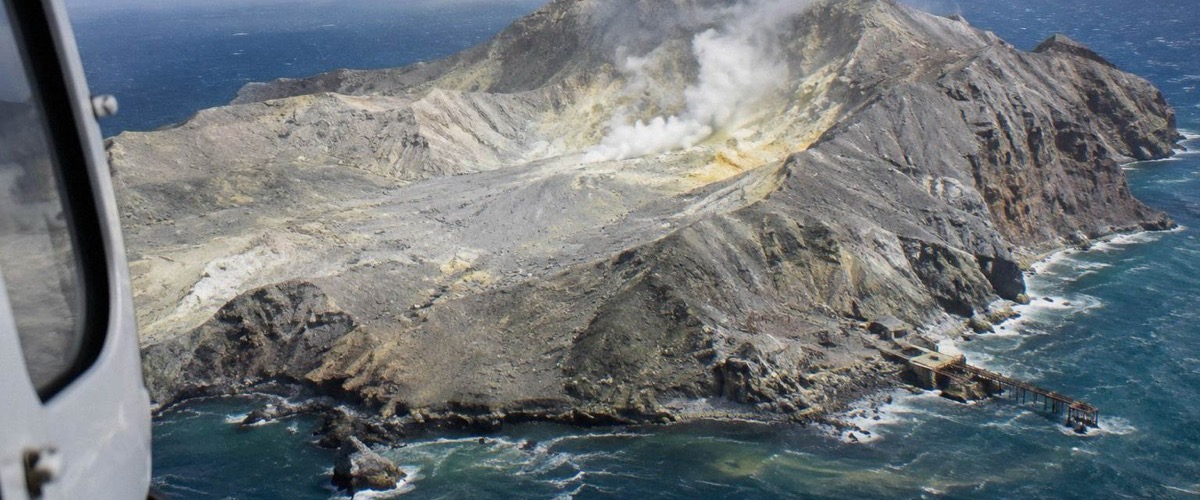
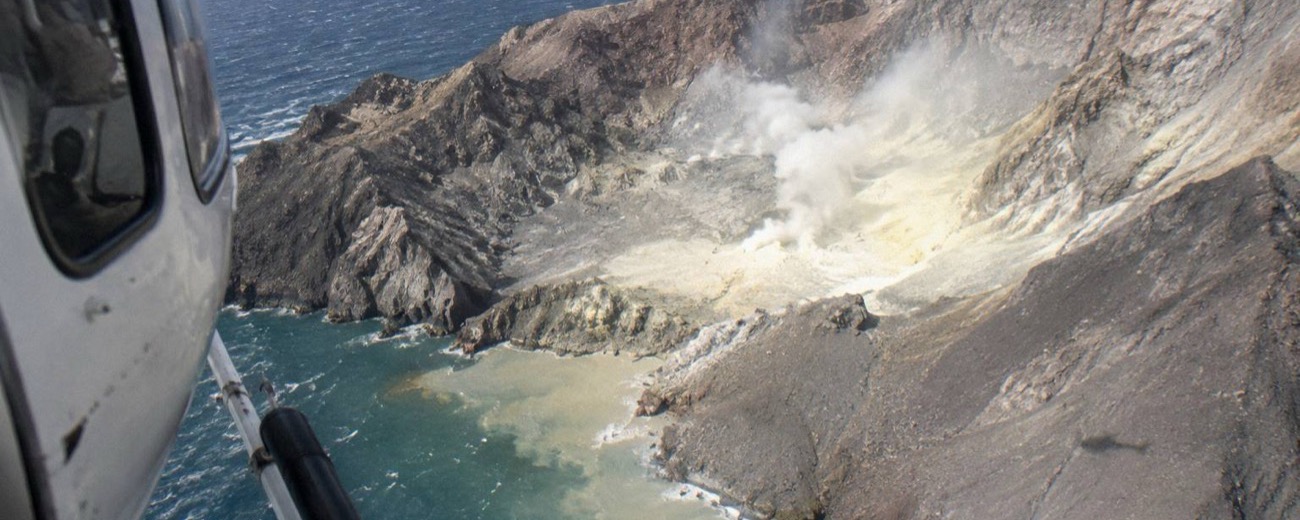
The circle exists because the volcano's value from the air is its shape and scale, read whole rather than piecemeal. A circling aircraft gives every side of the cabin a view of the crater walls and the steam, then turns back toward the Bay of Plenty coastline. The operator, Volcanic Air, describes Whakaari as New Zealand's only permanently active offshore volcano, wording that frames why the island draws flights at all: it is the one place on the itinerary where the ground is a live volcanic system sitting in open sea.
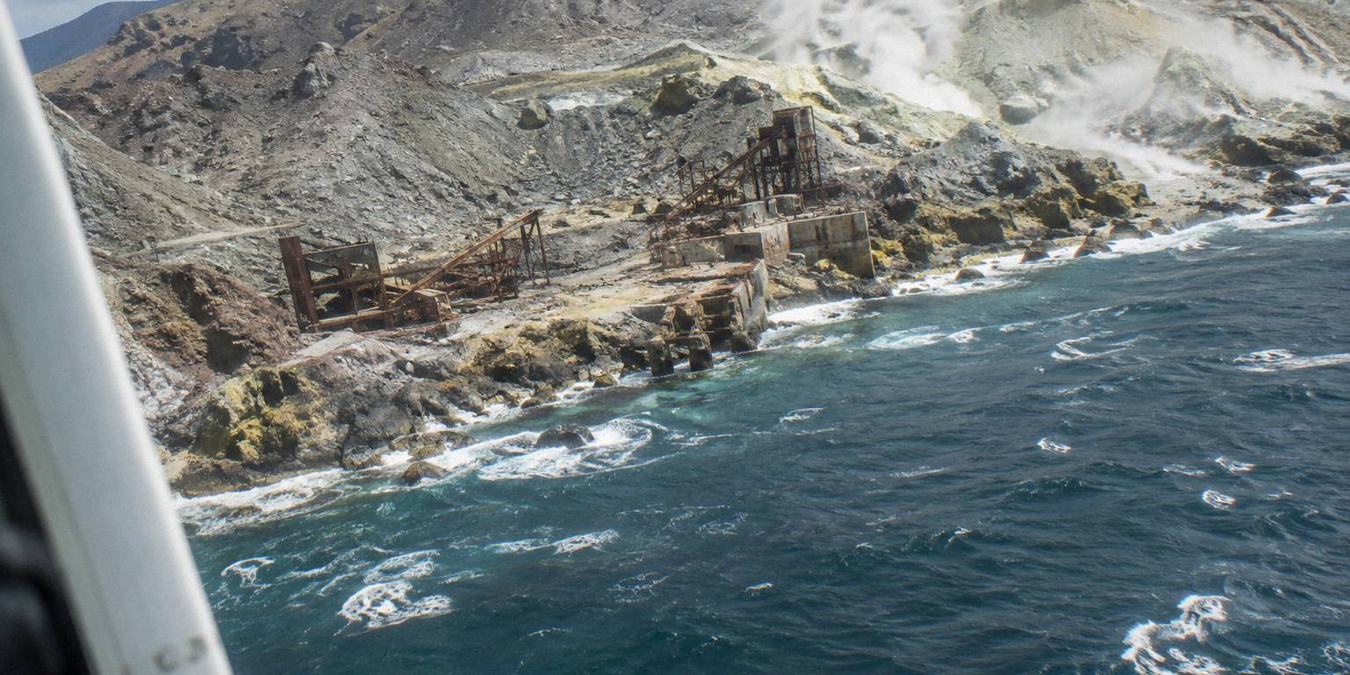
Circling also keeps the aircraft clear of terrain and inside sightseeing airspace rather than committed to a descent. Landings on volcanic ground carry specific risks the operator's own terms acknowledge, including geothermal activity and fast changing weather, and after 2019 the landing option at Whakaari was removed entirely. The flyover format carries the island's drama without the exposure. Passengers wanting the closest legal view of an active New Zealand volcano from Rotorua now get it through a window, from altitude, on a path the pilot controls.
Three flights from the Lakefront base put Whakaari in the itinerary. The White Island and Mount Tarawera Floatplane Adventure is a pure flyover pairing the offshore volcano with the mainland one. The fuller version, a 2 hour floatplane listed from NZ$1,230 per person, adds Waimangu Volcanic Valley to Whakaari and Mount Tarawera, with pilot commentary and aerial views of the lakes district, fertile farms, orchards and the Bay of Plenty coastline on the way out and back. It rates 4.7 from 7 reviews.
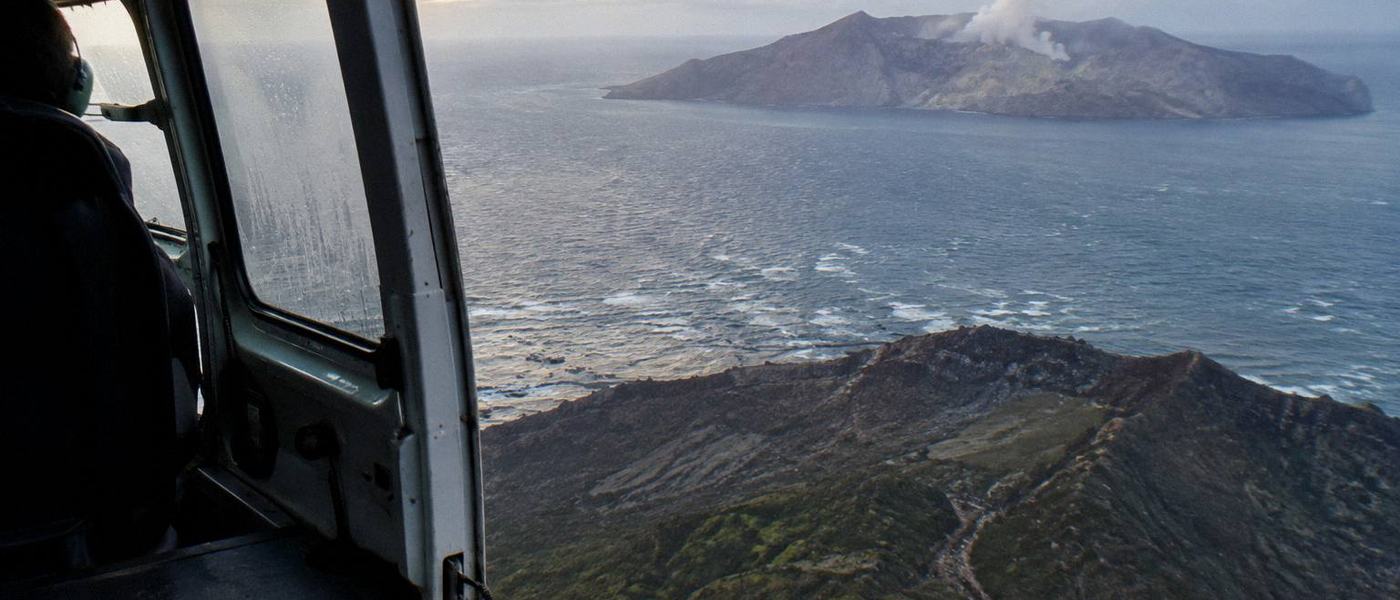
It is the one product that touches the ground anywhere, and the ground it touches is Tarawera, never the island.
The pairing logic is geographic and volcanic at once. Whakaari sits offshore in the Bay of Plenty; Mount Tarawera is the rifted ruin of the 1886 eruption inland; Waimangu Volcanic Valley formed along the line of that same rift. A single flight can link an active offshore volcano with the mainland's most consequential eruption site, which is why Tarawera and Waimangu appear beside Whakaari on both floatplane itineraries.
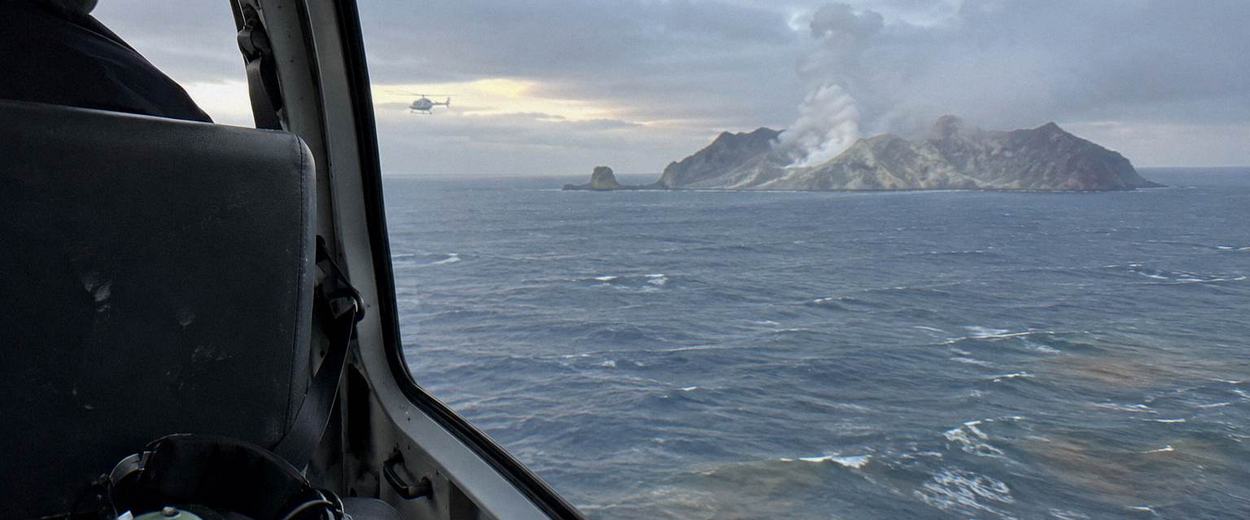
What remains off limits is the ground itself: no current Rotorua product descends to it, and the flyover format is the standing arrangement. Volcanic Air sells its Whakaari flights as floatplane flyovers, matching that reality, and the operator's description of the island as an offshore volcano is marketing language anchored in genuine geology.
Every flight, helicopter or floatplane, begins at the same place: the Volcanic Air office on the Rotorua City Lakefront at 1 Lakefront Drive, under a kilometre from the town centre. Helicopter passengers check in 30 minutes before departure; floatplane passengers 20 minutes before. The buffer is not decorative. It covers weigh-in, briefing and boarding, and arriving inside it risks the flight itself.
The weigh-in is the first order of business. Passengers are weighed individually because the aircraft must stay within balance limits, and the declared weight given at booking is checked against the scale on the day. The seat plan follows from the numbers: who sits where is decided by weight distribution across the cabin, not by preference, and passengers over 110 kg may be placed in specific seats on several flights.
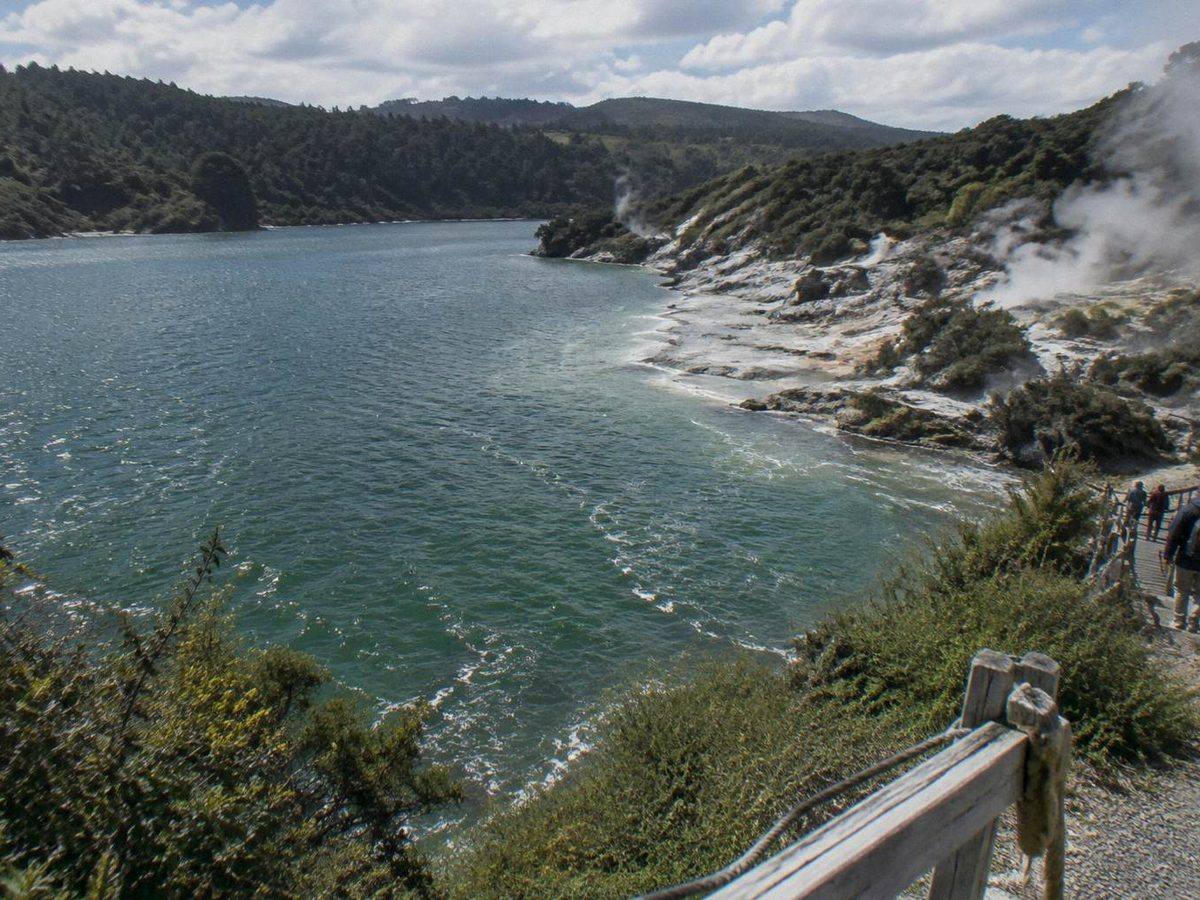
With weights recorded comes the full safety briefing, delivered at the Lakefront office before anyone walks to the aircraft. It covers the essentials the operator's terms return to later: staying seated and secured, following crew instructions, and, on flights with landings, how to board and leave the aircraft on terrain that may be hard ground or, for a floatplane, water. Guests with reduced mobility are asked to flag it at booking so assistance is agreed in advance, and the briefing rules apply to everyone aboard.
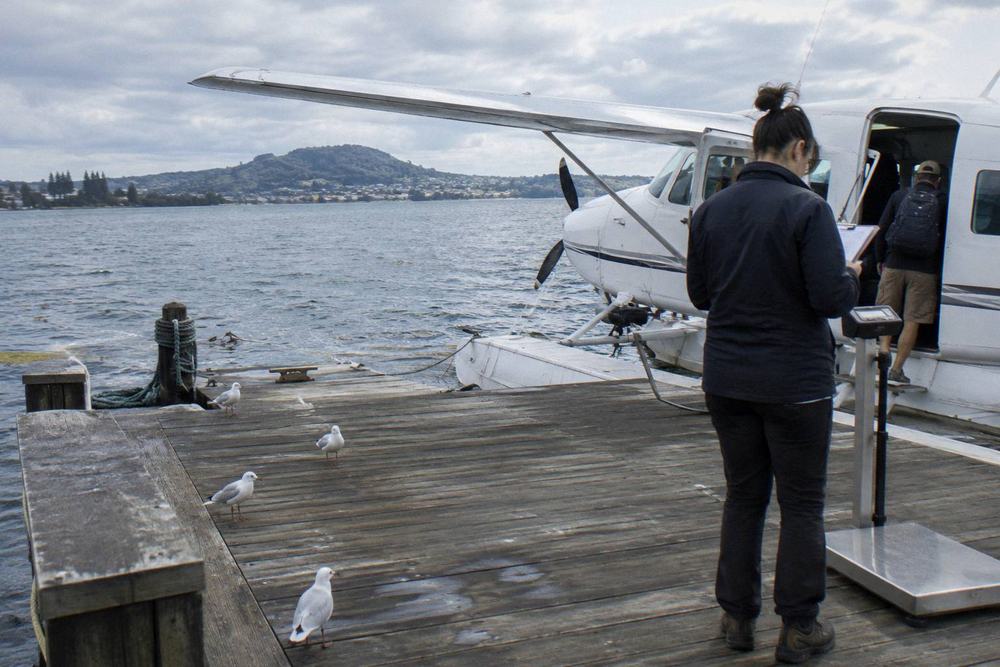
Boarding splits by aircraft. Helicopter passengers walk to the helicopter at the Lakefront; floatplane passengers go to the lakefront pier, where the aircraft takes off from Lake Rotorua itself. From check-in desk to wheels up or floats moving, the whole sequence runs on the operator's clock, which is why the 20 and 30 minute windows are quoted as fixed rather than suggested. Late arrivals are the one variable the operator cannot weigh, brief or board around.
Floatplanes lift off Lake Rotorua and climb around Mokoia Island, a native bird sanctuary, with views back over Sulphur Bay and the city. The Tarawera flight line then strings together lakes Okareka, Okataina, Tarawera and Rotomahana, the last sitting on the line of the 1886 rift, before the mountain itself fills the windshield: a summit of 1,111 m across three domes, Ruawahia the highest. Helicopter routes to the summit cross the same lakes, and the landing flight overflies the operator's described 8 km of rift and craters across the mountain top.
Helicopters can land on the Mt Tarawera summit for a 15 minute guided walk, at the pilot's sole discretion on the day, with excursion landings undertaken at the passenger's own risk; flight times and inclusions can also shift with weather, volcanic activity and passenger loads. Floatplanes cannot land on the mountain at all. Their touchdown is water: the Orakei Korako flight touches down on the winding Waikato River at the Hidden Valley, where a short ferry crossing carries passengers to the geothermal field and a self-guided walk among the park's active geysers and the cave the park says descends more than 36 m to the Pool of Mirrors.
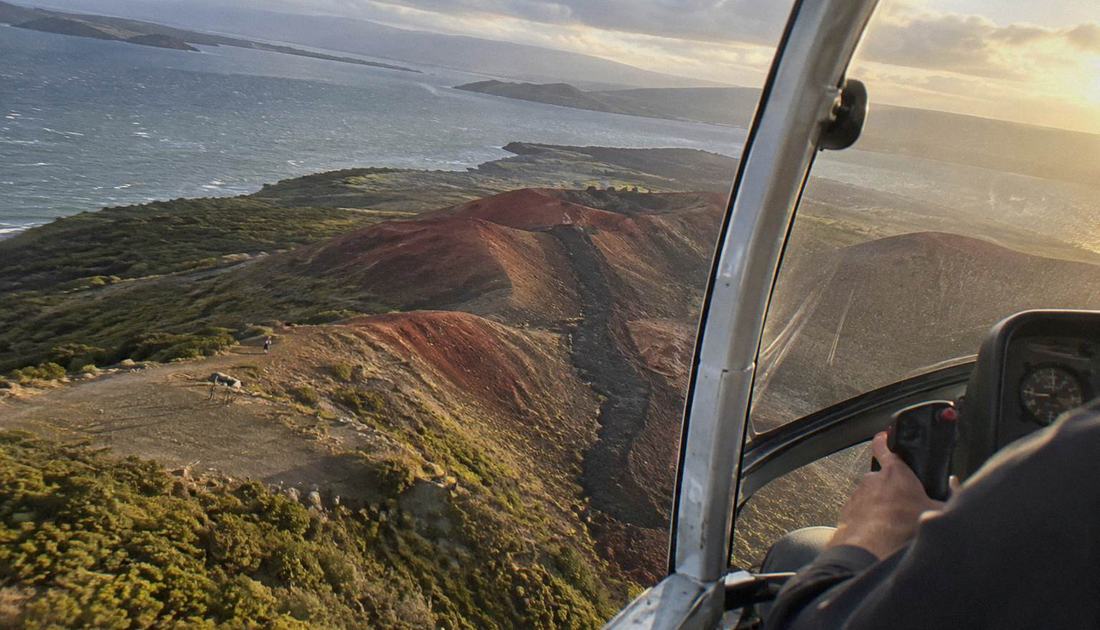
The longest helicopter tour combines both worlds, landing on Mount Tarawera for a guided walk, then ferrying across to Orakei Korako for a self-guided hour before flying on.
Returns are routed with their own views. The Orakei Korako floatplane flies back over farmland and the Paeroa Range before settling onto Lake Rotorua and taxiing to the Lakefront base. Every flight, whatever its landing story, finishes where it started: at 1 Lakefront Drive, with the walk back into Rotorua measured in minutes rather than hours. Cameras, sunglasses and a jacket earn their place in the cabin, and closed-toe shoes on any flight that lands.
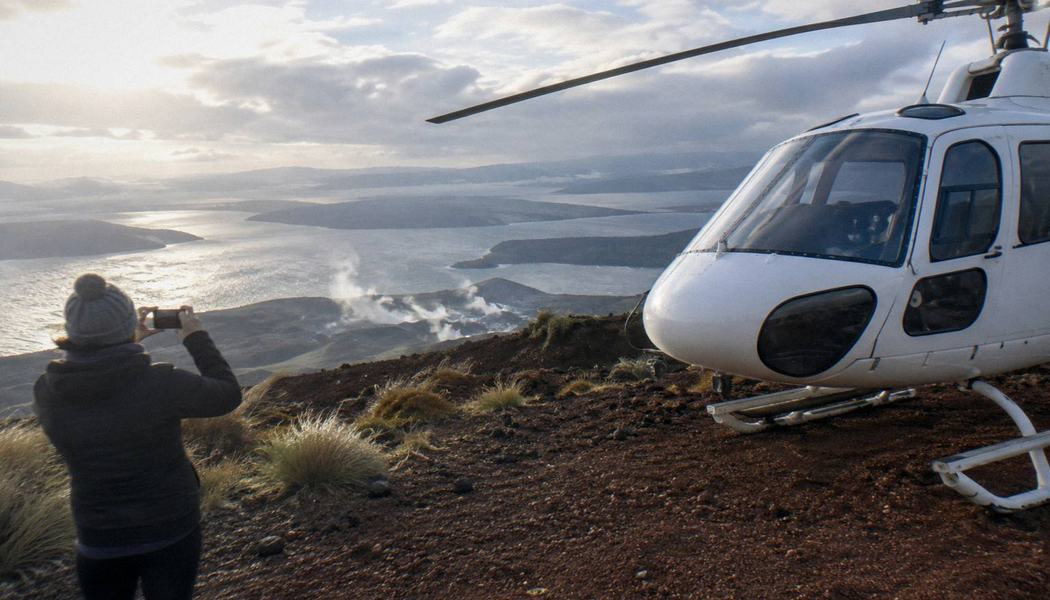
Every Rotorua helicopter tour and floatplane flight on file leaves from the same Lakefront base at 1 Lakefront Drive, but the inclusions split sharply between flyover products and landing products. The 15-minute crater lakes flights, helicopter or floatplane, are pure flying: 15 minutes in the air over the lakes district and back to base. The 40-minute Mt Tarawera and Waimangu scenic flight adds a full circuit of the dormant volcano, Waimangu Volcanic Valley, the crater lakes, Rotorua City and the Pohutu Geyser, with 30 of its 40 minutes spent airborne. Commentary comes from the pilot throughout.
The landing products stack more into the seat time. The Helicopter Flight and Guided Walk on Mt Tarawera pairs the scenic flight with a guided walk on the mountain and commentary from the guide; food and drinks are not included. The Volcanic Extremes helicopter tour runs an hour and 45 minutes and finishes with a Mt Tarawera summit landing, one of the longest helicopter products listed.
| Flight | Included |
|---|---|
| Scenic Floatplane, Tarawera And Waimangu | 40-minute experience, 30 minutes of flying, Scenic flight over the dormant volcano Mount Tarawera and the volcanic craters, Aerial views of Waimangu Volcanic Valley and the Crater Lakes, Fly over Rotorua City and the Pohutu Geyser |
| Helicopter Landing, Guided Summit Walk | Scenic helicopter flight, Guided walk on Mt Tarawera, Commentary from guide |
| Floatplane, Orakei Korako Landing | Floatplane flight over Rotorua's geothermal parks, Landing at Orakei Korako, Self-guided walk at Orakei Korako |
| Floatplane, Waimangu Included | Floatplane flight, Pilot commentary, Views of Whakaari/White Island, Mount Tarawera, and Waimangu Volcanic Valley, Aerial views of Rotorua’s lakes district, fertile farms, orchards, and the Bay of Plenty coastline |
| Geothermal Park Landing, 3 Hours | Helicopter flight, Landing on Mount Tarawera, Guided walk on Mount Tarawera, Aerial views of geothermal parks, 1-hour self-guided tour at Orakei Korako, Ferry transfer to Orakei Korako, Pilot commentary |
| Flight | Not Included |
|---|---|
| Scenic Floatplane, Tarawera And Waimangu | Nothing listed |
| Helicopter Landing, Guided Summit Walk | Food and drinks |
| Floatplane, Orakei Korako Landing | Meals and drinks, Hotel pickup and drop-off |
| Floatplane, Waimangu Included | Hotel pickup and drop-off, Food and drinks |
| Geothermal Park Landing, 3 Hours | Food and beverages |
The geothermal park tour, at 3 hours, is the fullest package on file: helicopter flight, landing and guided walk on Mount Tarawera, aerial views of the geothermal parks, a one-hour self-guided tour at Orakei Korako and the ferry transfer across to the thermal field. Food and beverages are not included. The Orakei Korako floatplane, a 2-hour product, includes the flight over Rotorua's geothermal parks, the river landing and a self-guided walk, with meals, drinks and hotel pickup listed as not included.
Two White Island products cover the Bay of Plenty coastline and the offshore volcano as flyovers. The longer one, 2 hours, includes pilot commentary and views of Whakaari, Mount Tarawera, Waimangu Volcanic Valley, the lakes district, farms, orchards and the coast; hotel pickup, drop-off and food are excluded.
The operator's packing guidance is short and practical. Bring a camera or phone, sunglasses and a jacket. The jacket matters even on warm days: doors stay shut in flight but lake-edge waits before boarding and after landing can be cool, and the Tarawera summit walk happens outdoors on mountain terrain.
Footwear depends on the product. Comfortable closed-toe shoes are the stated requirement for flights with landings, which covers the Tarawera summit products and both Orakei Korako landings. A summit walk on volcanic ground and boardwalks at a geothermal field both argue for solid soles over sandals. Flyover-only products, the 15-minute crater lakes runs and the Tarawera and Waimangu scenic flights, carry no stated footwear rule, though the same shoes do no harm when climbing in and out of a floatplane at the lakefront pier.
On food, plan to eat before or after rather than on board. The guided walk and volcano landing tours list food and drinks among the exclusions, the Orakei Korako floatplane excludes meals, drinks and hotel pickup and drop-off, and the 3-hour geothermal park tour excludes food and beverages. Three hours on the longest product, most of it outdoors, is a long stretch without refreshment.
Hotel pickup is not part of standard flights in any case. Direct pick-ups exist only for bespoke charters, so independent transport to 1 Lakefront Drive is the working assumption for all thirteen products. The base sits under a kilometre from the Rotorua city centre, which keeps that leg simple.
Every Rotorua helicopter tours booking starts with a number: each passenger's declared weight, given at the time of booking. The operator asks for this to keep safe and balanced seating in the aircraft, and passengers are weighed again on arrival. The terms are blunt about what follows a mismatch: a deviation from the declared weight can mean the flight is rescheduled, a surcharge is applied, or the booking is cancelled, at the operator's sole discretion.
| Rule | Operator Terms |
|---|---|
| At booking | Declare each passenger's weight; pounds, stones or kilograms are accepted |
| On arrival | Passengers are weighed; a different weight can mean rescheduling, a surcharge or cancellation |
| Over 110 kg | A surcharge may apply at the operator's sole discretion |
| Over 135 kg as weighed | Two adult fares are required |
| Children | Under 2 sit on a parent or guardian's lap; child rates apply from 2 to 11 |
Two thresholds frame the seat plan. Over 110 kg, a surcharge may apply at the operator's sole discretion. Over 135 kg as weighed, two adult fares are required, because one seat cannot legally or safely carry the load. Several booking pages carry their own version of the rule, noting that passengers over 110 kg may be subject to specific seating arrangements.
One helicopter listing, the Mount Tarawera Volcanic Adventure, states a total weight per passenger of 110 kg and a maximum of 6 travelers per flight. Six seats is the working capacity that makes these weight rules matter: with five other passengers sharing the cabin, where each person sits changes the aircraft's balance, and the operator uses the declared weights to plan the layout before anyone arrives at the Lakefront office.
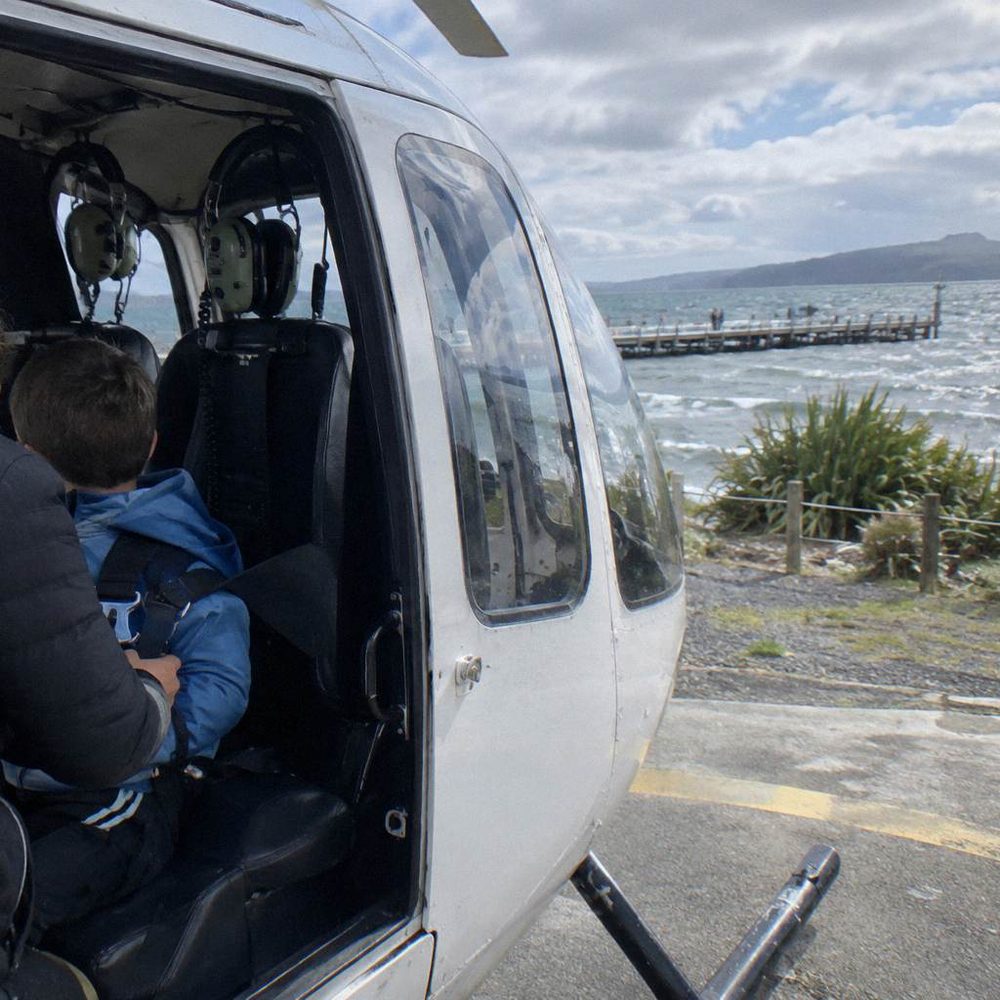
The weighing on arrival is not a formality; it is the final check that the planned load matches the real one. Declaring honestly at booking, including children's weights, is the cheapest way to avoid a surprise at check-in, which opens 30 minutes before departure for helicopters and 20 minutes for floatplanes.
| Situation | What Happens |
|---|---|
| Weather unsuitable | The operator works with you to reschedule or gives a full refund |
| Operator cancels before the flight starts | Full refund for weather or volcanic activity |
| Booking page terms | Free cancellation up to 24 hours before for a full refund |
| Poor visibility | One booking page says the flight will not go ahead if it is not safe or if the views cannot be seen |
All flights operate subject to suitable weather and safe flying conditions. If a flight cannot go ahead because of weather, the operator works with passengers to reschedule or provides a full refund, and the same full refund applies when the operator cancels before commencement for circumstances beyond its control, weather or volcanic activity among them.
One scenic flight's booking terms put the visibility point plainly: the tour will not go ahead if it is not safe to do so or if the views cannot be seen. Booked through the platform listings, cancellation is free up to 24 hours in advance for a full refund.
| Topic | Operator Guidance |
|---|---|
| Pregnancy | Not automatically a barrier; depends on weeks and the flight; talk to a maternity carer, especially from 28 weeks |
| Reduced mobility | Tell the operator when booking; guests must follow the briefing, stay seated and secured, and board with agreed help |
| Footwear on landing flights | Comfortable closed-toe shoes |
| Bring | Camera or phone, sunglasses and a jacket |
The terms also acknowledge the terrain honestly: flights land and take off on hard terrain or water, and natural hazards include earthquakes, geothermal activity, landslides and fast changing weather. Excursion landings are undertaken at the passenger's own risk and remain at the pilot's sole discretion on the day.
Pregnancy is not automatically a barrier. The guidance depends on the number of weeks, whether the pregnancy is uncomplicated and which flight is involved, and the operator advises talking to a maternity carer, especially from 28 weeks, and making contact with the due date before booking.
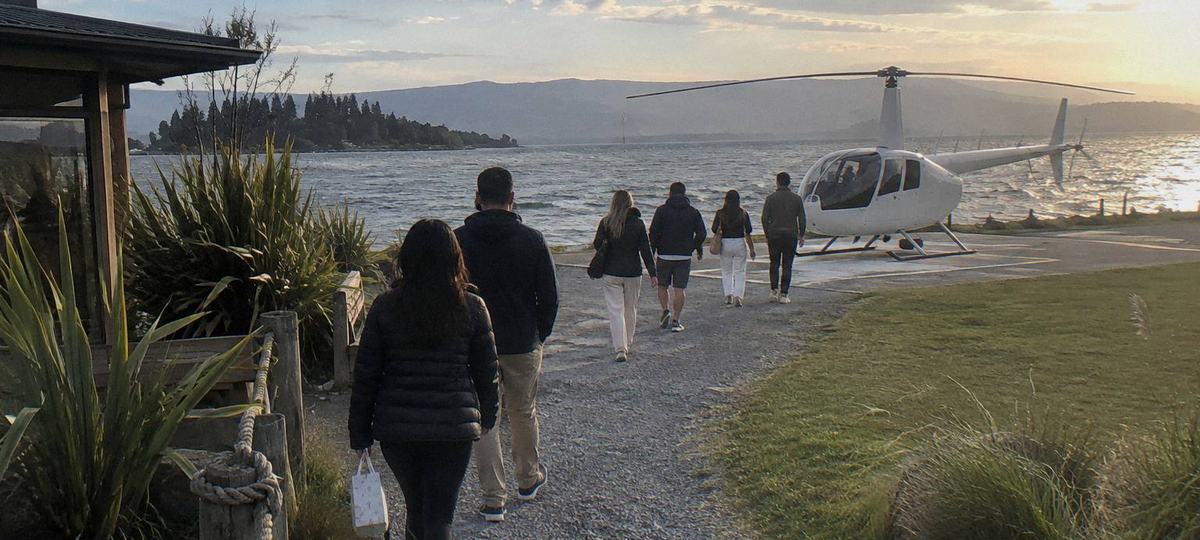
Reduced mobility is similarly not an automatic exclusion. The operator asks to be told at booking, and guests must follow the safety briefing, stay seated and secured in flight, and board and leave the aircraft with agreed assistance.
Children are welcome at all ages. Under 2s sit on a parent or guardian's lap, and child rates apply from ages 2 to 11; on the Tarawera landing flight, children aged 2 to 11 pay 75 percent of the adult fare with a minimum of two adult fares per booking.
Flights are listed for all twelve months of the year, operating in daylight hours from the Lakefront base. That year-round calendar makes the timing question less about season and more about the day itself, and the operator's own answer to the best time of day is that there is no hard and fast one: it depends on the weather that morning.
There is still a pattern worth knowing. Mornings often give the calmest weather and the smoothest flying, with soft light that suits photography. Afternoon flights can bring warmer temperatures and late-day colour, especially in winter. Neither slot is guaranteed anything, but the trade-offs differ.
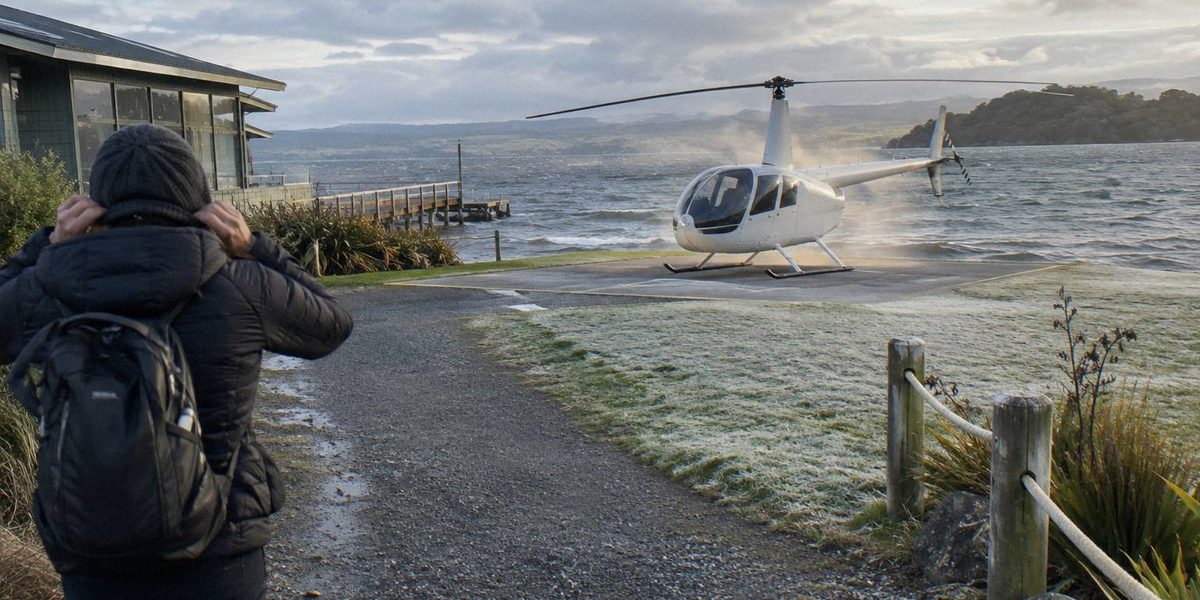
Across the year, Rotorua tourism describes the driest and warmest weather as running from late spring in October until early autumn in April. The rainfall normals bear that out in outline. November is the driest month on the record at 86.8 mm, October follows at 92.9 mm and January at 93.8 mm. The wettest stretch runs through the middle of the year: June at 131.9 mm, May at 130.2 mm, August at 125.2 mm and July highest of all at 137.4 mm.
March and February sit at 100.3 mm and 100.4 mm, April rises to 133.0 mm, September falls back to 106.6 mm and December stands at 117.1 mm.
Rainfall is an average, not a forecast, and a wet-month booking can fly in clear air while a dry-month booking meets cloud. The driest window simply tilts the odds. Whatever the month, the operator's practice stands: if conditions are unsuitable, they try to reschedule rather than leave the flight dead.
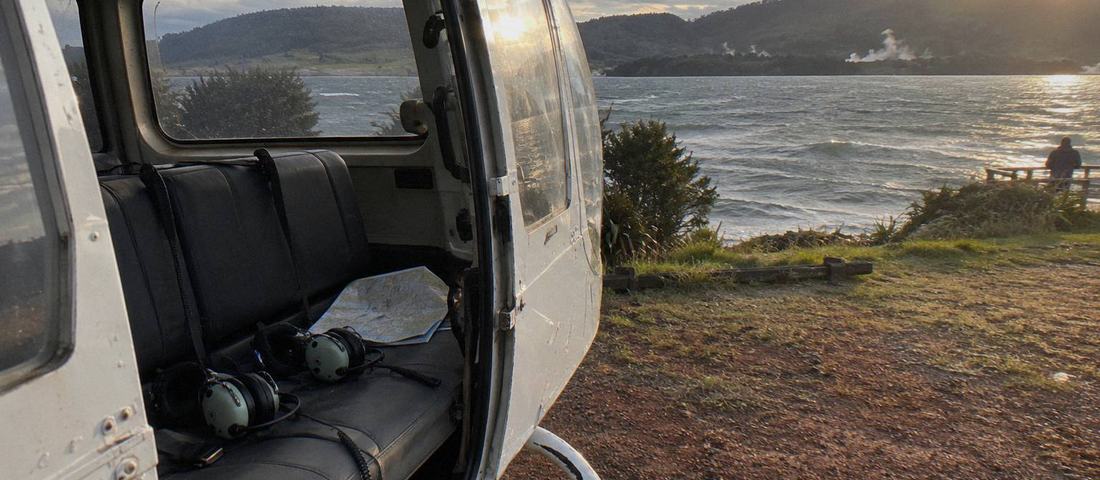
The monthly normals tell you where the risk sits, not whether your flight goes. July's 137.4 mm average against November's 86.8 mm marks the difference between the wettest and driest months on the record, roughly a 50 mm gap spread across a whole month, which works out at a modest daily difference. A Rotorua helicopter tours booking in July is not a lost cause; it is a booking that wants a spare morning behind it.
The record says nothing direct about visibility, haze or clarity by season, and no such claim belongs in a plan. What the sources do say is functional: every flight runs subject to suitable weather, and one scenic flight's terms state it will not go ahead if it is not safe or if the views cannot be seen. A flyover that cannot see the volcano has no product to sell, so the visibility test is built into the operator's own go or no-go decision, made on the day by the pilot.
| Period | What The Sources Say |
|---|---|
| All months | Flights are listed for all months of the year, in daylight hours |
| October to April | Rotorua tourism describes the driest and warmest weather as late spring to early autumn |
| Morning | Often calmest weather and smoothest flying, with soft light for photos |
| Afternoon | Can give warmer temperatures and late-day colour, especially in winter |
| Wettest months | July has the highest average rainfall, 137.4 mm; November the lowest, 86.8 mm |
The practical schedule, then, is a flexible one. Book the earliest workable morning in the trip, keep a later morning or the following day open, and treat the free cancellation up to 24 hours in advance as the tool for adjusting plans before the weather picture firms up. Mornings skew calmer, which favours the first departures of the day for the smoothest air and softest light.
Long products, the 3-hour geothermal park tour and the 2-hour Bay of Plenty flights to Whakaari, have the most to lose to weather and the most to reschedule around. Short 15-minute crater lakes runs are the easiest to refit into a spare gap. No sunrise flight is offered as a scheduled product; the calendar is simply daylight hours, every month.
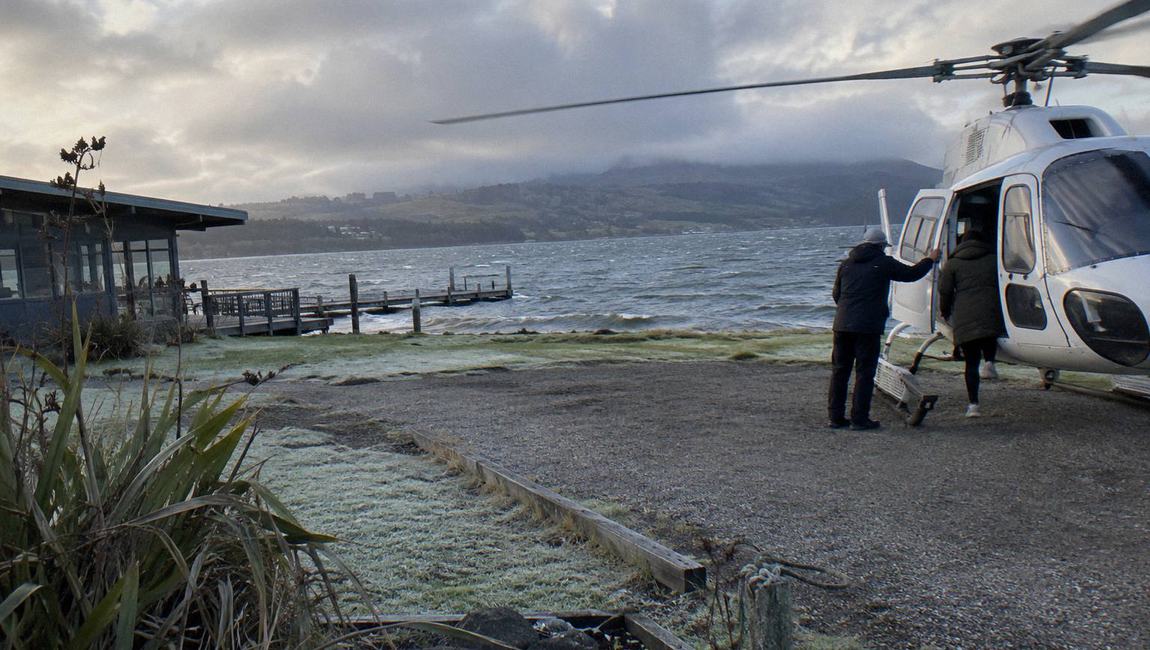
Five products on file carry a listed from-price. The Tarawera and Waimangu scenic flight opens at NZ$395 per person, the helicopter flight and guided walk on Mt Tarawera at NZ$675, the Orakei Korako floatplane landing at NZ$845, the White Island, Tarawera and Waimangu floatplane at NZ$1230, and the 3-hour volcano landing and geothermal park helicopter tour at NZ$1,490. The remaining eight products carry no listed from-price.
The ratings picture is strong where reviews exist. The Mt Tarawera helicopter tour with volcano landing rates 4.9 from 43 reviews, the Tarawera and Waimangu scenic flight 4.9 from 28, and the helicopter flight and guided walk a perfect 5.0 from 12. The dual landing thermal explorer scores 5.0 from 10 reviews, the Orakei Korako floatplane 5.0 from 8, and the White Island, Tarawera and Waimangu floatplane 4.7 from 7.
| Flight | From-Price Per Person | Rating | Flight Length | Starts From |
|---|---|---|---|---|
| Helicopter Volcano Landing | See live price | 4.9 from 43 reviews | Volcanic Air, Rotorua Lakefront | |
| Scenic Floatplane, Tarawera And Waimangu | NZ$395 | 4.9 from 28 reviews | 40 minutes | Volcanic Air, Rotorua Lakefront |
| Helicopter Landing, Guided Summit Walk | NZ$675 | 5.0 from 12 reviews | 40 minutes | Volcanic Air, Rotorua Lakefront |
| One-Hour Volcanic Adventure | See live price | No rating figure | Volcanic Air, Rotorua Lakefront | |
| Crater Lakes By Floatplane, 15 Minutes | See live price | No rating figure | 15 minutes | Volcanic Air, Rotorua Lakefront |
| Dual Landing Thermal Explorer | See live price | 5.0 from 10 reviews | Volcanic Air, Rotorua Lakefront | |
| Floatplane, Orakei Korako Landing | NZ$845 | 5.0 from 8 reviews | 2 hours | Volcanic Air, Rotorua Lakefront |
| Floatplane, White Island And Tarawera | See live price | No rating figure | Volcanic Air, Rotorua Lakefront | |
| Floatplane, Waimangu Included | NZ$1,230 | 4.7 from 7 reviews | 2 hours | Volcanic Air, Rotorua Lakefront |
| Volcanic Extremes, 1h45m Helicopter | See live price | No rating figure | 1 hour 45 minutes | Volcanic Air, Rotorua Lakefront |
| Geothermal Park Landing, 3 Hours | NZ$1,490 | No rating figure | 3 hours | Volcanic Air, Rotorua Lakefront |
| Tarawera Volcano Floatplane | See live price | No rating figure | Volcanic Air, Rotorua Lakefront | |
| Crater Lakes By Helicopter, 15 Minutes | See live price | No rating figure | 15 minutes | Volcanic Air, Rotorua Lakefront |
The volcanic adventure helicopter, the 15-minute crater lakes floatplane and the White Island and Tarawera floatplane each hold 11 or 8 reviews without a listed rating figure, and the volcanic extremes helicopter and the crater lakes helicopter carry 2 reviews and none respectively.
Lengths range from the two 15-minute crater lakes flights to the 3-hour geothermal park tour, with the volcanic extremes helicopter at 1 hour 45 minutes anchoring the long end for helicopters. All thirteen depart from the same check-in at 1 Lakefront Drive, helicopters from the Lakefront and floatplanes off the pier on Lake Rotorua.
Not by landing. Boat tours to Whakaari / White Island and helicopter flights that land on the island are currently suspended, so the only option from Rotorua is a flyover. Whakaari lies about 48 km off the coast of Whakatane, and Volcanic Air sells it as a floatplane flyover, describing it as New Zealand's only permanently active offshore volcano. The airspace restrictions were lifted in 2020.
Yes. Whakaari / White Island remains an active volcano monitored by GeoNet, which sets its volcanic alert level and can change it any day, so no fixed status should be assumed. The island was the site of the fatal eruption of 9 December 2019, which killed 22 people and injured 25 others. Check GeoNet before travel for the current bulletin.
Costs vary by aircraft, route and duration. Among Rotorua helicopter tours, listed from-prices start at NZ$675 per person for a 40-minute Mt Tarawera flight with guided summit walk. The longest option, a 3-hour volcano landing and geothermal park helicopter tour, lists NZ$1,490 per person. Other figures change with demand and aircraft type, so treat these as indicative starting points only.
That depends on the experience sought. A helicopter can land on the summit of Mt Tarawera, a mountain with no independent summit access, where landings are limited to authorised guided tours or approved helicopter operators. Review ratings suggest satisfaction runs high: the guided walk flight scores 5.0 from 12 reviews and the dual landing thermal explorer 5.0 from 10.
Operator terms spell out the hazards plainly: flights land and take off on hard terrain or water, and natural hazards include earthquakes, geothermal activity, landslides and fast changing weather. Volcanic Air describes itself as a Civil Aviation Authority certified NZ air operator, and excursion landings are undertaken at the passenger's own risk, at the pilot's sole discretion. A full safety briefing precedes every departure.
Per-person listed from-prices for two passengers on Rotorua helicopter tours include NZ$675 each for the 40-minute Mt Tarawera flight with guided summit walk and NZ$1,490 each for the 3-hour volcano landing and geothermal park tour. Note that the Tarawera landing flight requires a minimum of two adult fares. Final totals depend on the flight chosen and current pricing.
Durations span a wide range. The shortest crater lakes flight runs 15 minutes, all of it airborne. A 40-minute Mt Tarawera option pairs the flight with a guided summit walk, while the volcano landing and geothermal park tour runs 3 hours, including a Tarawera landing, a guided walk and an hour of self-guided time at Orakei Korako. The White Island Volcanic Extremes flight lasts 1 hour 45 minutes.
Helicopters can land on the summit of Mt Tarawera and at Orakei Korako; floatplanes cannot land on the mountain. Floatplanes take off from Lake Rotorua at the lakefront pier and can touch down on the Waikato River at Orakei Korako's Hidden Valley. One 15-minute crater lakes flight exists in each aircraft type, so a lake-view circuit can be flown either way.
Several Rotorua helicopter tours land on the summit, always at the pilot's sole discretion on the day. The landing flight crosses the mountain's 8 km of rift and craters and includes a 15-minute guided walk. Access matters here: independent summit access is not permitted, and the Ruawahia 2B Trust governs the mountain alongside Ngati Rangitihi, with tourism running through approved concessionaires.
No. Following the 9 December 2019 eruption, which killed 22 people and injured 25 others, there are currently no boat tours to Whakaari / White Island and no helicopter flights that land on the island. Rotorua flights over the island, about 48 km off Whakatane, are flyover only. A 2-hour floatplane option covering Whakaari, Mt Tarawera and Waimangu lists NZ$1,230 per person.
Weight must be declared at booking and passengers are weighed on arrival so the aircraft stays within balance limits. A declared weight that proves wrong can mean rescheduling, a surcharge or cancellation. Over 110 kg, a surcharge may apply at the operator's sole discretion; over 135 kg as weighed requires two adult fares. Booking listings also flag seating arrangements for passengers over 110 kg.
Yes, all ages are welcome. Children under 2 sit on a parent or guardian's lap, and child rates apply from ages 2 to 11. On the Mt Tarawera landing flight specifically, children aged 2 to 11 pay 75 percent of the adult fare, and a minimum of two adult fares applies. Comfortable closed-toe footwear is recommended on flights with landings.
Neither is automatically a barrier. Pregnancy depends on the number of weeks, whether it is uncomplicated and which flight is involved; the operator advises talking to a maternity carer, especially from 28 weeks, and contacting them with the due date. For reduced mobility, tell the operator when booking; guests must follow the safety briefing, stay seated and secured, and board and leave with agreed assistance.
All flights operate subject to suitable weather and safe flying conditions. If weather stops a flight, the operator works to reschedule or gives a full refund, and operator cancellations before departure carry a full refund. Weather can also ground a flight when the views cannot be seen. Booked listings allow free cancellation up to 24 hours in advance for a full refund.


